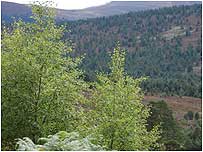
 | Glen Tanar Estate lies in the heart of Royal Deeside in Scotland which covers 25,000 acres. This stunning wilderness location has everything a nature lover could want - mountains, rivers and lots of Caledonian pine forest. | | Glen Tanar - prime pine forest. |
Spectacular birds
 The forest boasts some of the most spectacular and specialised creatures to be found anywhere in the UK including the highly secretive Capercaillie. The forest boasts some of the most spectacular and specialised creatures to be found anywhere in the UK including the highly secretive Capercaillie.
This turkey sized bird is dependent on the Caledonian Pine Forest for its very survival. The Capercaillie is a big bird that can't be missed - they crash their way through the woods at 40mph. The bird is a super-sized member of the grouse family, but it's also a bird that's under a lot of pressure and overall numbers are still low. The Blaeberry - known in England as the Bilberry - is the key to the Capercaillie's survival. It acts as a host for caterpillars and other insect life which in turn are food for the Capercaillie's chicks. The plant is susceptible to being crowded out by heather and bracken, but at Glen Tamar those plants are controlled. Where the Blaeberry thrives, it is hoped that the Capercaillie will do well too. Woodland Pines  The Scots Pine, the dominant tree of the first wild wood to appear after the ice age ended. The Scots Pine, the dominant tree of the first wild wood to appear after the ice age ended.
Only a few remnants remain and this estate contains one of them. The reason why these trees are so important is that a whole range of creatures depend on it today for its survival - including one bird that can be found in Scotland and nowhere else in the world. Crossbills are almost totally dependent on Scots Pines for their feeding. The bird's bill has an adaptation for twisting open the scales of the pine cones to get at the seeds inside. Naturalists used to think all the Crossbills in the UK were one species - in fact it's now been nailed down that the Scottish variety is a distinct species of its own. Salmon supreme  There's another specialist of the Scottish Highlands that can be found on the estate - the Salmon. There's another specialist of the Scottish Highlands that can be found on the estate - the Salmon.
The Dee is one of our best British salmon rivers - and in autumn the Glen Tanar estate is one of the best places to see them spawn. Spawning on the Dee takes place between October and November when the female fish lay their eggs. Spawning sites are used year after year with the Salmon returning to the same places they lived. The male fish fertilises the females eggs, then the female covers the eggs by moving gravel over the completed nest. The result is one of the richest Salmon rivers in the British Isles.
Photo credits Salmon photograph copyright of PA Images. Crossbill image courtesy of Michael and David Callan. Capercaillie courtesy of RSPB Images and Desmond Duggan. |