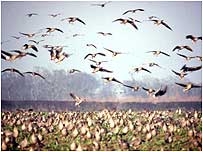
 | Abbey Farm is in the village of Flitcham in West Norfolk. Covering 375 hectares this tenant farm on the Sandringham Estate has been farmed by the Cross family since 1958. | Abbey Farm - birds in flight.
Photo - Abbey Farm Organics. |
Abbey Farm straddles the chalk scarp that runs north-south through West Norfolk, so ranges from 80 feet to 250ft above sea level.
The Farm includes the most easterly, regularly flowing springhead of the River Babingly. The main crops are barley, sugar beet and peas, grown using conventional methods. About one tenth of the farm is grassland, most of which is near the river springhead. Pink foot paradise  Abbey Farm is particularly associated with conservation of wet grasslands and the recreation of dry grasslands using seeds gathered from the local area Abbey Farm is particularly associated with conservation of wet grasslands and the recreation of dry grasslands using seeds gathered from the local area
The most numerous bird to visit Flitcham is the Pink-footed Goose. Up to 20,000 visit Abbey Farm and some individuals come back year after year. This is about 6% of the world population, so for this brief time Abbey Farm supports internationally important numbers. Eighty per cent of the world's Pink-feet breed in Iceland and Greenland, and then fly to Britain for the winter. So, during these cold months, this area is very important to this species. The geese mostly feed on agricultural land in North Eeast Scotland, Lancashire and Norfolk. Norfolk boasted over 100,000 Pink-footed Geese in the winter of 2005-06. Sweet billed  In Norfolk the main food for the Pink footed Geese is what is left on fields after sugar beet has been harvested. In Norfolk the main food for the Pink footed Geese is what is left on fields after sugar beet has been harvested.
At Abbey Farm they leave these 'beet tops' (it is the roots that have the sugar in and are taken from the field during harvest) out for the geese as long as possible before ploughing ready for the next crop. Large numbers of geese are present in Norfolk between October and February. They have special coastal roost sites where they spend the nights before flying out onto farmland at dawn to start feeding. When fresh beet tops are available on Abbey Farm, the geese start arriving at first light, usually coming from the roost on the eastern edge of The Wash. The numbers of geese on the farm depends on how recently the farm has been harvesting sugarbeet, a job that is done in 3-4 weeks spread out between October to January. The wildlife page on our website has information about goose numbers and how easy they are to see. Goose cavalcade If there are many thousand of geese, they can take over an hour to all arrive. They are not protected from shooting, so are very nervous of people approaching on foot, and can also be disturbed by vehicles, especially if they stop nearby. Apart from that (and low-flying aeroplanes and large birds of prey like Red Kites), not much worries them and they mix their day with feeding, preening and napping. Once they find a good field they return day-after-day until all the best food is gone. Then there may be no geese until another beet field is harvested. Barley browsers  The geese can cause problems by grazing winter barley. This is sown in September, so is a few inches high when the geese arrive. The geese can cause problems by grazing winter barley. This is sown in September, so is a few inches high when the geese arrive.
Given the chance, the geese will graze this crop as an alternative to beet. To keep the geese off barley fields, a vehicle is parked in the fields and bags or flags used to frighten them off. Some of the geese have coded rings that enable you to identify individuals. Some geese have returned over several winters. The geese are spectacular and are very welcome visitors to Abbey Farm. Generally the geese are best seen from distance arriving at dawn and leaving at dusk. Other birds  Over 180 species of bird have been recorded on Abbey Farm. This total includes fleeting rarities, such as Black Stork, that just pass through, and others from the coast that are having a day out, like Gannet and Arctic Skua. Over 180 species of bird have been recorded on Abbey Farm. This total includes fleeting rarities, such as Black Stork, that just pass through, and others from the coast that are having a day out, like Gannet and Arctic Skua.
Others, like Little Gull and Red Kite, are uncommon birds, individuals of which find the farm a good place for a few weeks, but then might not be seen again for years. As well as these uncommon birds, there are the typical common species of inland, wetland and farmland sites in West Norfolk. Alongside these are species which are of particular interest because they have declined nationally or regionally, or because they are less common locally Furry friends  Brown Hares and Rabbits are the most often seen mammals on Abbey Farm (excluding people and the herd of Beef Shorthorn cattle!). Brown Hares and Rabbits are the most often seen mammals on Abbey Farm (excluding people and the herd of Beef Shorthorn cattle!).
There are also lots of Moles, especially on the meadows and organic farmland. Fallow, Roe and Muntjac Deer are seen occasionally, as is the Harvest Mouse. Stoat and Weasel are more common, but still not frequent. Water Vole was last seen in the late 1990's. Noctule bats are easily seen at dusk during the summer and early autumn. Daubentons, Long-eared and Pipistrelle Bats are also frequent.
Find out more about watching British bats
Photo credits
Images courtesy and copyright of Abbey Farm Organics. Red Kite copyright of RSPB Images/Gomersall. |