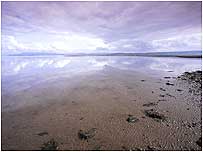
 | Lough Foyle is famous for its autumn migrants with wildfowl and waders in abundance including Whooper Swans and Brent Geese. In autumn the birds are here for one thing - the mud and food which the Lough provides. | | Lough Foyle - top autumn bird watching spectacle. RSPB Images/ Andy Hay. |
 Lough Foyle is the name given to the estuary of the River Foyle - it starts where the Foyle leaves Derry. Lough Foyle is the name given to the estuary of the River Foyle - it starts where the Foyle leaves Derry.
The lough separates the Inishowen peninsula from Northern Ireland. There is a saying, that when one is on a boat on Lough Foyle, one is at the only place in the world where north is south, and south is north. This makes sense when you realise that the Republic of Ireland is referred to as 'The South' in Northern Ireland, while 'The North" is a common term for Northern Ireland.
Whooping good time  Lough Foyle is one of the best places in the British Isles to see the amazing Whooper Swan. Lough Foyle is one of the best places in the British Isles to see the amazing Whooper Swan.
The birds arrive in mid autumn following their long and arduous journeys from Iceland. In late autumn you can see large numbers of waterfowl, including Brent Geese and Whooper Swans. These expert flying machines are easy to spot as they fly overhead - their wing beats are almost silent. In comparison, Mute Swans are much noisier - you'll be able to hear the clapping of their wings as they fly above you. These migrant birds use Lough Foyle as a restaurant, grazing on the farmland adjacent to the lough. The geese and swans pick over the arable fields feasting on waste potatoes, sugar beet and other arable crops. Vibrant mud  The mud flats of the Roe Estuary exposed at low tide appear dull and lifeless - but underneath they hide a secret. The mud flats of the Roe Estuary exposed at low tide appear dull and lifeless - but underneath they hide a secret.
Concealed by the mud are vast numbers of small seashore animals such as lugworms, shrimps, ragworms and periwinkles. There are also large beds of mussels and extensive areas covered in a plant known as eel grass. All these are the food sources that act as a magnet for many of the thousands of migrating waders, ducks, swans and geese that stop over on Lough Foyle each winter. The geese and swans also pick over the arable fields feasting on waste potatoes, sugar beet other arable crops. Lapwings and Otters  Inside the railway bridge is an area of salt marsh vegetation - a habitat not common locally. Inside the railway bridge is an area of salt marsh vegetation - a habitat not common locally.
Here you can watch the Lapwings' aerobatic display in early summer, or hear the plaintive cry of the Curlew on a misty autumn morning.
If you are lucky, you might catch a glimpse of an Otter hunting crabs in the shallow pools.
Photo credits Images courtesy and copyright of RSPB Images, Sue Tranter and Andy Hay. |