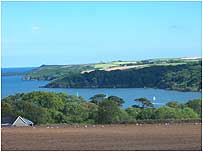
 | The secluded Helford River estuary in Cornwall offers 47 kilometres of unspoilt shoreline. Rising sea levels created by melt waters during the Ice Age 10,000 years ago resulted in the beautiful Helford landscape which visitors enjoy today. | | Helford Estuary. Image - Pamela Tompsett and Helford VMCA |
The Helford area is less rugged and gentler in topography than other parts of Cornish coastline.
Helford boasts a variety of wildlife habitats from rocky shores and reefs to sandbars and mud flats. Oyster fishing  Eighty species of fish and shellfish have been recorded in the estuary including Sea Bass, Cuttlefish' Lobsters and Crabs. Eighty species of fish and shellfish have been recorded in the estuary including Sea Bass, Cuttlefish' Lobsters and Crabs.
The mouth of the estuary is also home to Sea Anemones, Star-Fish, Sponges Sea Urchins, and Sea Squirts. Helford is world famous for its oysters - in fact the history of oyster fishing in the area dates back to Roman times. Traditionally the wild oysters are harvested from November 1, having bred and propagated naturally over the summer in the estuary's relatively warm water. Oysters have an interesting sex life - they can change gender or become hermaphrodites for a period of time! They are farmed at about three or four years old.
These shellfish are an indication that the estuary is rich in marine life, something that makes it an ideal place for a spot of rock pooling. Rock pooling and birding  Autumn is perhaps the last chance to go rock pooling during the year - and Helford is one of the best places in the country to do this. Autumn is perhaps the last chance to go rock pooling during the year - and Helford is one of the best places in the country to do this.
When the tides are out at Helford, the mud flats and rock pools are exposed - a good time to get out and about looking for interesting marine life. Look out for crabs, lumpsuckers (a greyish blue fish with a large sucker on its underbelly), and different varieties of sea-weed including red, green and brown.
The sands and mud of the estuary boast huge numbers of invertebrates, and make rich feeding grounds for estuarine birds especially at low tide, including the Little Egret. Little Egrets  This bird is most commonly associated with a tropical climate, and some naturalists believe that global warming could be helping them to flourish in parts of the British Isles. This bird is most commonly associated with a tropical climate, and some naturalists believe that global warming could be helping them to flourish in parts of the British Isles.
Prior to 1957 there had been just 23 recorded sightings ever of this bird in Britain.
Today there are thought to be over 1,000 Little Egrets around Britain and Ireland at any one time. During the autumn their numbers swell along the coast with the arrival of birds from the continent - so a visit at this time of year is highly recommended. Some birds stay all year whilst others are purely autumn and winter migrants. Seal sanctuary  Helford Estuary is also great for an encounter with seals, which can be seen throughout the year at the National Seal Sanctuary at Gweek. Helford Estuary is also great for an encounter with seals, which can be seen throughout the year at the National Seal Sanctuary at Gweek.
Created in 1958 the sanctuary deals with sick and abandoned seals and pups as well as injured birds. Most of the seals are released back into their natural environment, but some remain at the sanctuary to be cared for long term. It's a great place to get an introduction to some of our larger marine creatures. There's also a chance to see other creatures such as Sea Lions and Otters.
Photo credits  Helford images courtesy and copyright of Pamela Tompsett and Helford VMCA. Helford images courtesy and copyright of Pamela Tompsett and Helford VMCA.
Seal images copyright of the National Seal Sanctuary. |