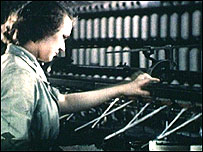
During the war, cotton could no longer be exported to the foreign markets and those countries, particularly Japan, set up their own factories. Not only were these countries producing their own cloth, they were doing it more cheaply than Britain. By 1933 Japan had introduced 24 hour cotton production and became the world's largest cotton manufacturer. The demand for British cotton slumped and mill owners put cotton workers on short time, or closed the mills altogether. In-between the wars, 345,000 workers left the industry and 800 mills closed. 'Trouble at mill' 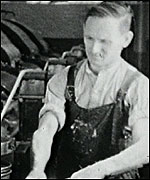 | |
Trouble brews at the mill |
India accounted for half of Britain's cotton exports, but as part of his campaign for Indian independence, Gandhi called for a boycott of imported Lancashire cotton. The boycott had devastating affects on Lancashire and in Blackburn, with 74 mills closing in less than four years. The First World War may have spelt the beginning of the end for the textile industry, but the Second World War brought about a short reprieve. Lancashire mills were enlisted to make parachutes and uniforms for the front and mill owners were forced to rally up new recruits. In the 1950s and 60s there was a huge influx of workers from the Indian sub-continent who were encouraged to seek work in Lancashire. An increased work force allowed the mill owners to introduce a third shift or night shift to the working routine although many workers were less than pleased with the changing hours. Too little, too late 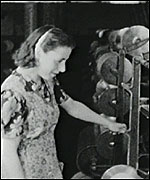 | |
The end of king cotton |
The resurgence in the textile industry was short lived and by 1958, the country which had given birth to the textile industry became a net importer of cotton cloth. The Cotton Industry Act of 1959 was intended to help modernise and amalgamate the industry. Mill closures occurred throughout Lancashire, but cost cutting did little to improve industry profits. Lancashire was still failing to compete with foreign competition. During the 1960s and 70s, mills were closed across Lancashire at a rate of almost one a week. By the 1980s the textile industry of the North West had all but vanished. Only the empty factories and northern towns which sprung up as a result, were left - a legacy of an industry that was once the pride of Britain.
Key events in the North West Textile Industry Pre 1760 - Cotton is spun by hand at home 1760 onwards - The rise of the factory system. 1803 - Cotton overtakes wool as Britain's biggest export 1820 onwards - The era of the machine - steam power allows machine-led production in the industry 1825 - George Stephenson builds the first public steam railway - the Stockton to Darlington line 1833 - The first Factory Act is passed regulating child labour 1847 - Government pass the Ten-Hour Act. The 70-hour week becomes 55.5 hours 1912 - The industry reaches its peak, producing 8 billion yards of cloth 1914 - World War One - cotton can no longer be exported to the foreign markets. Those countries set up their own factories. 1933 - Japan introduces 24 hour cotton production and becomes the world's largest cotton manufacturer 1950s - Huge influx of workers from the Indian subcontinent allowing extra shifts 1958 - Britain becomes a net importer of cotton cloth 1959 - The Cotton Industry Act is passed to help modernise and amalgamate the industry 1960s/70s - Mills are closed across Lancashire at a rate of almost one a week 1980s the textile industry of the North West is over |