

Interview: Peter Stark
Interview
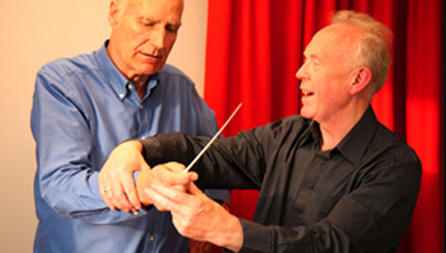
Maestro's music advisor Peter Stark reveals the secrets of conducting.
How would you sum up the craft of conducting?
Conducting combines two essential elements: the art of communication and the art of leadership.
How does a conductor communicate
There are three aspects: baton technique, body language and talking.
What's involved in baton technique?
It doesn't matter if you're left- or right-handed – to the players, what you do is a mirror image anyway, so they won't be confused by that. Although most conductors are right-handed, interestingly, three of our Maestro students are left-handed.
In a nutshell, the baton hand is for the grammar and the other is for the poetry of the music. Conductors need to sort out the grammar – tempo (speed), dynamics (loud or soft), and articulation (smooth or detached) – because there's a common language within these technical indications: beyond that, the players want to see the poetry.
Is a baton even necessary?
It's not essential – many conductors (e.g. Valery Gergiev, Kurt Masur, Mark Elder etc) do without, but I think it helps. It extends your hand, concentrating the energy and offering greater clarity and precision to the players who only ever have time to glance at you.
Beyond marking the beat, what does the baton do?
Beating time comes primarily from the wrist; but in physiological terms there are other motors: fingers, elbow and shoulders. If you think about how you use gesture when you're speaking, making use of all those motors enables you to communicate a whole range of feelings and degrees of emotion: it's the same when conducting music.
Are we in the realms of body language now?
Yes. As well as the outward signs in the form of arm movements, there is an abstract side to body language: some argue that it can't be taught because it's created by our own reaction to what's going on, and you can’t necessarily teach someone how to react. But there is a lot that you can do with body language because it's observed: the word 'dynamic' – in the adjectival sense – is in the world of body language, and you only have to look at conductors at work to see that it can mean very different things: Solti, for example, was dynamic in the sense that his style was extrovert – explosive energy, whipping the players along. By contrast, Klemperer (particularly after his stroke) and Reginald Goodall, used only minimal gestures although their performances certainly didn't lack any dynamism.
The poetic gesture can heighten an extraordinary moment, or bring drama to a cadence. It's a bit like a 'stage whisper' - in some senses not a quiet thing, but more a projection of quiet which travels right to the back of the audience.
Is body language a conductor's way of exercising authority over an orchestra?
Well, it's true that orchestras can make their minds up about conductors' abilities from the moment they walk into the room. To be a good conductor, you have to be slightly detached, and you must never forget that it's the players who actually play the notes. Great conductors recognise that the most important person in the room is the composer. That's where words come in. The players need to feel there is a vision of the work, so the conductor must be able to express in words new and inventive insights into a piece that is already thoroughly familiar; adjectives are vitally important in rehearsals! And when it comes to new music, the players will expect the conductor to act as a guide through the technicalities of the piece and draw all the elements together into a satisfying whole.
Does personality come into this?
Of course! But the relationship between orchestras and conductors has changed in the last few decades. The age of the great autocrats like Toscanini has all but disappeared. Perhaps a hundred years ago the towering figures were composers who conducted – such as Mahler and Strauss – nowadays it's less common (with a few notable exceptions). The cult of celebrity is still prevalent though, particularly in a world driven by the media and recordings, as very few people really understand what it is a conductor actually does.
The shift is partly about where the power to hire-and-fire lies in the mixed economy of the orchestral world. It is certainly true to say that these days orchestras increasingly understand the world of conducting.
What about leadership qualities?
This comes with the personality. The psychology of leadership a fascinating subject on its own; and ‘delivery and reception’ is the issue. The projection of the musical idea is the delivery (and the conductor should always know how the idea is meant) but how it’s received by the players (or indeed audience and critics as well) is entirely up to them. Compare with the throwing of a ball – everyone will catch it slightly differently.
So with conductors, it's not just about how they move, it's about how they grab the situation and exercise their leadership...
The key to it is respect. Conductors cannot expect players to respect them unless they have first paid their own respect to the orchestra. All conductors can relate to the feeling of vulnerability, which at times is too frightening to imagine. The art of conducting requires a longer learning process than almost any other human activity, and most of it is done whilst feeling you have no clothes on!
Related Articles
 22.08.08
What the papers said ...
I watched Maestro (BBC2) mostly because it was there … how wrong could I be because it was riveting.
BBC iD
BBC iDBBC navigation
BBC links

BBC © 2014The BBC is not responsible for the content of external sites. Read more.
This page is best viewed in an up-to-date web browser with style sheets (CSS) enabled. While you will be able to view the content of this page in your current browser, you will not be able to get the full visual experience. Please consider upgrading your browser software or enabling style sheets (CSS) if you are able to do so.
