
Documentary - Sleevenotes

Director's Notes: Jill Nicholls
Series Producer Jill Nicholls directed the first two episodes of the Folk America documentary. Here she writes about her team's travels through the United States in search of the country's musical past.
TRAVELLIN' ON...
We arrived in Memphis in July boiling hot and jet-lagged and headed straight off South down the freeway to Mississippi to find a small blues festival in a town that no longer exists - Avalon, where Mississippi John Hurt lived out his days. An odd-job man for a white farmer, he'd done some recordings in the late 1920s of his mischievous ragtime guitar-playing and gentle singing voice - gospel songs like I Shall Not Be Moved, 'bad man ballads' like Frankie and Stagolee, and a fond tribute to his birthplace, Avalon Blues. Though he left and went north for a while when he was 'discovered' by the 60s folk and blues revival, he returned there to die.
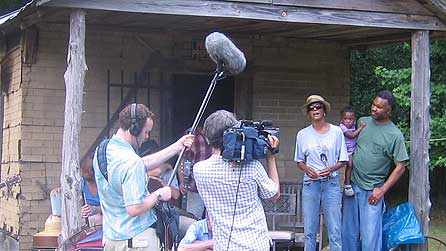
We'd arranged to meet his granddaughter, Mary Hurt Wright. She too was raised in Avalon but hated the racism and poverty of the place, and escaped as soon as she could to study and work in Chicago. But lately she's felt drawn back to Avalon by her memories of her grandfather and his uncanny ability to transcend the hardships of life through music. She has opened the little shack where he lived as a museum and runs the annual festival in his honour.
She was a revelation herself - so passionate, so eloquent. As the three of us stood in the field filming an interview with her - Daniel Meyers on camera, the assistant producer Luke McMahon on sound and me, Jill Nicholls, directing and interviewing, the heavens opened. The whole festival had to huddle into the shelter of the tiny shack and we filmed hard rain falling through the window. We really felt we'd arrived in the South, where all this music which inspired the 60s folk revival was first recorded in the 1920s.
Our next stop was also in Mississippi, though many miles of driving to the East - the town of Meridian, where Jimmie Rodgers was born and worked the railways. Known as 'The Singing Brakeman', he quit trains for music because he had TB, which cut his life short in 1933. By then he had become a huge star not just in the South but all over America - outselling even the opera star Caruso. There's a local museum for Jimmie Rodgers, too, and we went there to get shots of his photographs, flyers and cowboy boots - he's known as the Father of Country Music, though he of course recorded before 'country music' had been invented as a term.
Local TV turned up to see what we were up to, and by the time we filmed next morning in the scorching sun by Meridian railway station, we were local heroes ourselves, because we'd been on the evening news. All along the way, local media were intrigued that we were interested in musicians who'd emerged from their areas so long ago, and they were asking us all about them. This happened particularly when we were at a ruined cotton mill in North Carolina, filming sequences to do with banjoist Charlie Poole, who had worked in the mills there from the age of nine. Local reporters couldn't believe that the BBC had heard of him, and knew more about him than they did!
We passed through the rundown town of Shaw in Mississippi, where bluesman David 'Honeyboy' Edwards was born - he is one of the old-time survivors in our series. He is now 94, but was outclassed by Slim Bryant, a guitarist from Atlanta, Georgia who is now 100, and Wade Mainer, a banjoist from the Appalachians, who is 101. Wade moved to Detroit over 50 years ago to work on the line in the car factories there, so later in our journey we did a detour to Detroit - where we also interviewed Josh White Junior, son of balladeer Josh White, who was perhaps the most fascinating figure in the 40s and 50s folk boom - his story features in episode two, This Land is Your Land.
Crossing Louisiana, we filmed in the legendary Leadbelly's home town and at his grave - the first few days of the trip, we thought we might raise suspicions, as we were visiting a graveyard every night! The most moving was that of Blind Lemon Jefferson, the first and the biggest selling male bluesman of the 1920s. He is said to have died of cold in Chicago in 1929, at the onset of the Depression, and was buried in an unmarked grave in the 'negro cemetery' in the small town of Wortham, Texas, where he was born. It wasn't until the 21st century that a headstone was made for Blind Lemon, bearing the words of his most famous song, See that My Grave is Kept Clean. Indeed, the whole cemetery was re-named after him - we filmed the great arched sign, 'Blind Lemon Jefferson Memorial Cemetery', against a glorious sunset sky. And we filmed the harmonica that a loyal fan had left lying upon his grave.
In Texas we met Blind Lemon's descendants, and also interviewed Anna Lomax, daughter of Alan Lomax and granddaughter of John Lomax, the most famous of America's folksong collectors. She now runs an archive of her father's work in New York. Then we raced north to Oklahoma, for the annual Woody Guthrie festival. Woody was born in the small town of Okemah, where his father was a land speculator and local politician. But in the depression his father went bankrupt and his mother was shut away as insane, though in fact she had Huntington's Chorea, which would eventually kill Woody too. Age 14 he was left to fend for himself. By his late teens he was living in Pampa, Texas, reading out the library there, practising yoga, becoming a husband and father very young - and then joining the drift west, towards California, where he joined his cousin's show on a local country radio station. But the drift west with the dustbowl 'Okies' opened his mind to poverty and injustice, and his indignation started to come out in his songs. At the festival we interviewed his younger sister Mary-Jo who recalled his 'itty bitty arms, itty bitty legs' - and how annoyed their father had been at his radical politics - politics which chimed perfectly with the folk movement of the 30s and 40s.
We were on this voyage of discovery for a month, staying at motels, eating endless hamburgers and fried green tomatoes. Soon afterwards director Ben Whalley was back in the States with Daniel and Luke to do more interviews in New York and on the West Coast, particularly targeting musicians from the 60s folk revival, which forms the subject of episode three - Blowin' in the Wind.
It was a fascinating time to be in the States, with the elections looming. Cameraman Daniel Meyers, an American living in Paris, asked every petrol pump attendant and waitress we came across in the South what they thought of Barack Obama - from their reactions, we thought he was set to win. Josh White Junior, about 60 himself although he looks a lot younger, said with tears in his eyes that he never thought he would have the chance even to vote for a black person in his lifetime, let alone see the possibility of one becoming president. The times they are a'changing.
One of the last and best interviews we did was with Odetta, the powerful singer and civil rights activist. She died not long afterwards, and we are making a tribute to her, using that interview and a wealth of concert footage, which will be shown on BBC Four along with the third and final film in our series.
BBC iD
BBC iDBBC navigation
BBC links

BBC © 2014The BBC is not responsible for the content of external sites. Read more.
This page is best viewed in an up-to-date web browser with style sheets (CSS) enabled. While you will be able to view the content of this page in your current browser, you will not be able to get the full visual experience. Please consider upgrading your browser software or enabling style sheets (CSS) if you are able to do so.
