BBC Review
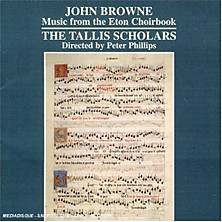
John Browne's body may lie a-mouldering in some unmarked grave, but the reasons the...
Andrew McGregor2005
John Browne: ordinary name, extraordinary music. I needn't detain you too long with biographical details...there are precious few.
Browne 'flourished around 1500', which means we don't even know his dates - but scholars have pinned him down to the household of John de Vere, the Earl of Oxford, who kept one of the grandest private chapels of the time, and where Browne was one of the chaplains.
There were royal connections: the Earl was godfather to Prince Arthur, heir to the English throne, who died in his teens in 1502...and it seems likely that Browne's Stabat iuxta, which depicts Mary in mourning at the foot of the cross, was written for Henry VII's wife Queen Elizabeth - sharing her grief at the loss of her son, the Prince of Wales and future king. It's scored for four tenors and two basses - which confines the vocal range of the work to a mere two octaves. But if you think Browne's emotional palette will be at all restricted, think again: the dense harmonies and imaginative textures are constantly surprising...and made very clear both by the vocal quality of the Tallis Scholars, and by director Peter Phillips' decision to perform these pieces at relatively high pitches.
We wouldnt have any of Browne's music were it not for the Eton Choirbook, which lists 93 works by different composers copied at the turn of the 16th century for use at Eton College. We may know almost nothing about John Browne, but his contemporaries held him in high regard; not only did the Eton Choirbook contain 15 of his works (more than almost any other composer), but pride-of-place at the start of the collection was given to Browne's O Maria salvatoris.
It's a remarkable piece of eight-part polyphonic writing that according to Peter Phillips has no precedent in European music at the time, and its opening phrases soar heavenwards at the end of the CD with breathtaking ease and accuracy. Phillips is spot on in his notes when he's trying to explain what gives Browne's music such impact; it's not just the innovation and imagination, but his emotional range...think Monteverdi rather than Palestrina, he reckons.
There have been more theatrically emotional recordings of Browne's masterpiece, his Stabat mater. But emotional understatement may have been a typically English quality even around 1500, and anyway the sheer beauty and crystalline perfection of these performances from the Tallis Scholars, with those high-flying treble lines so radiantly recorded, make this an unforgettable and richly rewarding experience.
John Browne's body may lie a-mouldering in some unmarked grave, but the reasons the experts consider him the greatest English composer of his time have never seemed more apparent than they do on this remarkable disc.
Like This? Try These:
Lalande: Music for the Sun King (Ex Cathedra)
de Rore: Missa Praeter rerum serium (Huelgas Ensemble)
Pergolesi: Marian Vespers (Choir of New College, Oxford)
 This work is licensed under a Creative Commons Licence. If you choose to use this review on your site please link back to this page.