BBC Review
Perez and the Orquesta Sinfonica de Tenerife work wonders, matching the scale of...
Andrew McGregor2004
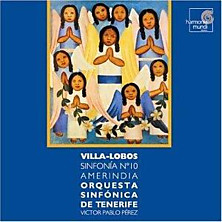
What have we here? A sprawling, 67 minute choral symphony by indisputably the greatest and most influential Brazilian composer of the 20th century. Villa-Lobos calls it a symphony; everybody else calls it a cantata, despite the purely orchestral first movement. 'Amerindia' was written in 1952 for the 400th anniversary of the city of Sao Paulo, and the work follows in the footsteps of Saint José de Anchieta, who gave the name Sao Paulo to the humble cabin which served him as church, school, home and hospital. Father Anchieta was from Tenerife in the Canary Islands, schooled in Portugal, and sent to Brazil by the Jesuits, where he seems to have been largely responsible for the missionary strategy of creating small catholic village communities, protecting the local nomadic tribes from the ruthless Portuguese colonisers and slave traders. It's Father Anchieta's story and his epic poem in praise of the Virgin Mary that underpin Villa-Lobos's Tenth Symphony: an allegorical, historical and religious account of the city.
The first movement ('The Earth and its Creatures') crunches into action with an elemental rhythmic vitality reminiscent of The Rite of Spring, but without the leanness that makes Stravinsky's scoring so much more effective. The second movement is headed 'War Cry', yet it's surprisingly gentle, a lament for the country lost to the colonisers. Villa-Lobos sketches a lush landscape of sweeping strings and succulent brass, with a wordless chorus that adds something of the timeless quality of Ravel's 'Daphnis and Chloe'. By now the symphony feels like an epic, but what sort - symphonic or Hollywood?
The third movement Scherzo is named after the iurupichina monkeys, filled with their restless vitality, and the chorus sings in the native Tupi language of the need to build houses, but their inability to do so.
The fourth movement is enormous: 27 minutes in this recording, and it's here we meet father Anchieta for the first time. There's Tupi again, mixed with Latin and Portuguese - the languages of the natives, the missionaries and the settlers. Three musical styles as well: simple melodies in the native Indian style, tonally ambiguous music for the outsiders, and syncopated rhythms for the Afro-Brazilian people, plus birdsong, and traditional percussion instruments mixed with the huge orchestra.
Finally: 'Glory in Heavens and Peace on Earth', a vibrant hymn of praise, a celebration of the founding of a city, with resounding Alleluias.
Does it work? As a celebration for Sao Paulo, certainly...so it's salutary to note that the symphony's premiere took place in Paris five years too late, and had a very mixed reception. As a Latin-American 'Symphony of a Thousand' it struggles, Villa-Lobos's sincerity undermined by the Technicolor soundtrack syndrome: Sao Paulo filmed by Cecil B. de Mille. Yet there are extraordinary things here, spectacular visions and passages of transcendent beauty. Already there are three recordings, one of which is yet to be released, and the first (from Uruguayan conductor Gisèle Ben-Dor, who takes a lot of the credit for the symphony's re-discovery) was an important landmark in 2000...but it's less expansive and atmospheric than the new one (although the notes are more helpful). Perez and the Orquesta Sinfonica de Tenerife work wonders, matching the scale of the score with the commitment of their performance and there's something quietly satisfying about hearing the 'Amerindia' Symphony performed by an orchestra that lives and works in the place Father Anchieta's pilgrimage began almost 500 years ago.
Like This? Try These:
New World Symphonies (Ex Cathedra)
Missa Mexicana (The Harp Consort)
Bernstein: Chichester Psalms (Bournemnouth SO/Alsop)
 This work is licensed under a Creative Commons Licence. If you choose to use this review on your site please link back to this page.