| 24 September 2014 |

| |
| BBC Homepage | | |
| |||
| Contact Us | | |
History featuresYou are in: Manchester > History > History features > The Saint of Manchester? 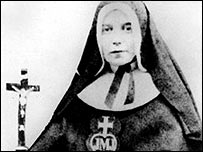 Elizabeth Prout The Saint of Manchester?A Victorian nun who devoted her life to helping poor Mancunian women has been put forward to be considered for sainthood and unsurprisingly, her life story is one of courage, hard work and stead-fast belief. Elizabeth was born in Shropshire in 1820. The daughter of Edward, a non-practising Catholic, and Anne, who was Church of England, she lived in the area until 1831, when the brewery where her father worked shut down. For the next decade, the family moved around Staffordshire as Edward searched for work. 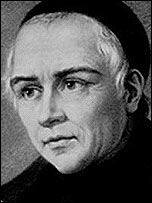 Blessed Dominic Barberi Around the time of her 21st birthday, Elizabeth attended a lecture in Stone by Father Dominic Barberi, a Passionist (a Roman Catholic religious order). The experience transformed the youthful Elizabeth; shortly after, she converted to Catholicism. At the time, Catholics suffered persecution and religious intolerance in the UK. Indeed, even her parents couldn’t cope with Elizabeth’s new faith, responding to the decision by disowning her. Elizabeth found her way to a convent in Northampton, where she became a novice. However, her training was cut short when she contracted tuberculosis. She was deemed unsuitable for religious life and sent back to her parents to recover. The Prouts welcomed her back, her mother hoping that her flirtation with Catholicism had now passed. Eventually her health returned, though not her allegiance to the Church of England. No sooner was she well than she began practicing Catholicism again, eliciting the same response from her parents as before; Elizabeth was once again thrown out of the family home. Cottonopolis callsHer saviour came in the form of Father Gaudentius Rossi, a companion of Father Dominic, who offered her a teaching job at St Chad’s in Cheetham Hill. Elizabeth happily accepted. Nothing she had experienced in her life could have prepared her for Manchester. Arriving in 1850, she found herself in an increasingly sprawling metropolis, its expansion driven by the cotton trade, often at the expense of the workers. 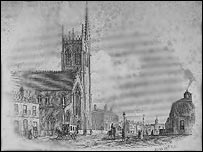 St Chad's in 1850 (c) Manchester Libraries Elizabeth felt compelled to do something. She began helping the poor around St Chad’s and gathering with like-minded women for prayer meetings. Such was her fervour that she even turned down a marriage proposal in favour of her work – though she was also considering leaving to enter a convent in Belgium. Again, Father Gaudentius stepped in to change her life. After meeting with many of the working women, he found they desired a religious life, so spoke to the leaders of St Chad’s about founding a community to receive such women, suggesting Elizabeth as their leader. A family of sistersIn March 1851, Elizabeth moved to 69 Stocks Street, renaming the house ‘St Joseph’s Convent’ and setting up an institute, ‘The Catholic Sisters of the Holy Family’ (the name would later be changed to ‘The Sisters of the Cross and Passion’). By November, the community had grown to the point that the leaders of St Chad’s decided to formalise the positions of Elizabeth and six other women, presenting them with religious dress – though such was the poverty of the time that they received nothing more than their own clothes dyed black. Still, a new religious community was born. A revolutionary orderThe idea of the order was revolutionary; it was intended that the sisters would support themselves through work and also find time for prayer. In practice, such ideals were hard to stick to. Not only was there mass poverty in Manchester, but riots in the summer between Irish immigrants and English mobs had only fuelled anti-Catholic sentiments. 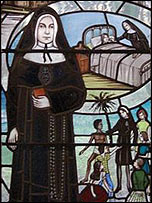 Stained glass commemorating Mother Mary Joseph Against the odds, Elizabeth, now known as Mother Mary Joseph of Jesus, and her sisters managed to get by, founding a community that offered many things to the local women; education in day, night and Sunday schools, shelter in the form of hostels, and spiritual and practical help. A new FatherDespite this, there were those who believed that Mother Mary Joseph was taking the institute in the wrong direction. Indeed, one of her biggest critics was Father Gaudentius, who issued instructions which the sisters were simply incapable, for financial or moral reasons, of following. Thankfully, he was moved by his superiors and the sisters fell under the jurisdiction of Father Ignatius Spencer (the great-great-great uncle of Diana, Princess of Wales), who was liberating and encouraging. With Father Ignatius’ help, Mother Mary Joseph weathered the criticisms that were levelled and set about revising the institute’s rules, so they could be presented to the Vatican – no mean feat given the fact that at the same time, Manchester was dealing with the ‘cotton famine’ brought on by the American Civil War. 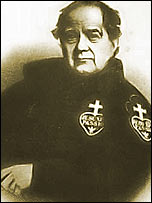 Father Ignatius Spencer The shortage of materials meant there was mass unemployment, a situation Mother Mary Joseph responded to by sending her nuns out to teach sewing and cookery to the jobless, offering them different employment opportunities. Good news, bad newsIn May 1863, temporary approval was given by the Vatican to the institute. Happy as the order were, it was not enough to distract them from the fact that Mother Mary Joseph was now terminally ill with tuberculosis. Regardless of this, the meeting of the first General Chapter of the Sisters of the Holy Family unanimously chose her as their first Superior General. On 11 January 1864, Mother Mary Joseph died at Sutton Convent in Lancashire with Father Ignatius by her side. She was only 43 years old. The aftermathIn 1887, the Vatican gave its final approval to the rules, formalising the order which still exists today, with congregations in ten countries across three continents. In June 1973, Mother Mary Joseph’s body was exhumed to be reburied next to that of Father Ignatius Spencer in the Church of St Anne & Blessed Dominic in Sutton, an appropriate resting place for the two friends, as both have now been put forward for canonisation. Whether the Vatican grants such an honour will be decided at some point in the future, but regardless of their decision, there is no doubt that Elizabeth Prout deserves her place in history as a strong, kind woman and a great advocate for women having a role in society. last updated: 16/07/2008 at 17:27 SEE ALSOYou are in: Manchester > History > History features > The Saint of Manchester?   |
| | About the BBC | Help | Terms of Use | Privacy & Cookies Policy |