 | 28 October 2014 |

| |
| BBC Homepage | | |
| |||
| Contact Us | | |
Science & TechnologyYou are in: Manchester > Science and Nature > Science & Technology > Making a mint Imperial Making a mint ImperialHow often have you gone to the garage to pick up your car, only to be told that it’s going to need more work? It’s a bit irritating, but it’s not as bad as the only surviving model of a Mancunian motor, which has been waiting 25 years to be fixed! 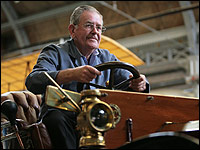 John at the wheel of the Imperial But then when you consider the age of the motor, it’s not too long. The Imperial, housed at the Museum of Science and Industry, was built in 1904, and it’s fallen to volunteer John Williams to try and get the old girl running again; something that is no easy task as early car designers were still trying to decide what worked in an engine and what didn’t. "I have to try and imagine what the car engineers at the time were thinking,” says John. “When they made these things, there was no right or wrong way round; people bought parts from different manufacturers and just put them together as their own car. It’s quite a challenge." An Imperial timeThe Imperial Autocar Manufacturing Company was set up by William Turner on Faulkner Street (now part of Chinatown) in 1900, at a time when several ventures were being set up around the city, not least one by Henry Royce, close to Turner’s existing cycle shop on Stretford Road. 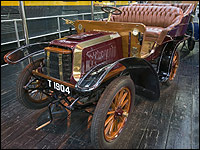 The 1904 Imperial The company produced up to 150 Imperials of four different styles, designed to carry either two or four people, and while they may have been desirable things, they certainly weren’t cheap. At a time when the average factory worker was earning less than £2.50 a week, the cars retailed for a massive £250. For that price, you didn’t get much. There was no roof, no windows, no doors, no lights, no boot, wooden spokes on the wheels and steering wheel, a brass horn and upholstered seats. In many ways, it was a simple copy of a horse drawn vehicle. But at least you got a bit of speed and a certain fuel economy. In 1902, a five horsepower model took part in the sixth annual Liverpool road trial, an 83 mile round trip between Merseyside and Blackburn. The Imperial faired well, completing the course on a mere 3.75 gallons of petrol (that’s around 22 miles to the gallon – better than some modern cars) and reaching a maximum speed of 6.4 miles per hour. 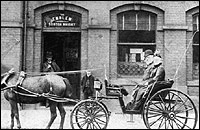 The common mode of transport in 1904 The company later moved to the former Manchester Corporation Tramway Company’s horse tram depot, where the Imperial which now sits in MoSI was built in 1904. Billy Turner went on building cars until 1912, before concentrating on garages and coach building. "A bit of a toy"As this is the only Imperial left, MoSI are a little nervous about its restoration, but, as transport curator Nick Forder puts it, "the opportunity to see it running again will be worth a few more grey hairs". 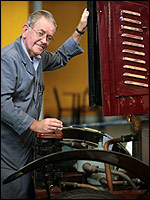 Under the bonnet of the Imperial That said, Forder is aware that while the Imperial is an important part of Manchester's engineering history, it wasn't that useful in its day. "They were really not a practical mode of transport and would have been something that the wealthy classes would have regarded as a bit of a toy to impress friends with in their spare time. It was not particularly comfortable, and would have needed constant maintenance just to get it going." That constant maintenance is now John’s job and it’s hoped the restored Imperial will be ready for MoSI’s classic car rally in August. Given the unusual nature of the engine and the fact that it’s leaking oil because all the seals have perished, it might be a case of wait and see, but rest assured, it won’t be another quarter of a century before we see it in action again. last updated: 18/10/07 You are in: Manchester > Science and Nature > Science & Technology > Making a mint Imperial  [an error occurred while processing this directive]  [an error occurred while processing this directive] |
| | About the BBC | Help | Terms of Use | Privacy & Cookies Policy |
