 | 28 October 2014 |

| |
| BBC Homepage | | |
| |||
| Contact Us | | |
Science & TechnologyYou are in: Manchester > Science and Nature > Science & Technology > Stan the T. rex: facts 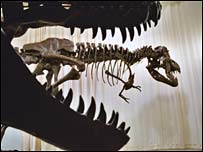 Jaws: T. rex teeth on show Stan the T. rex: factsWhat do we know about Stan? What can we tell from his skeleton? How old was he? How big, how tall? How did he live? And was T. rex as bad as they say? Find out more about Manchester Museum's 'king of the terrible lizards!' Stan: factfileSpecies: Tyrannosaurus rex Lived: Upper Cretaceous, 65 million years ago Found: Spring 1987, nr Buffalo, South Dakota Length: 12.2m (40 ft) Weight: 5.4 tonnes Age: approx. 20yrs Stride length: 18 ft In the Spring of 1987, amateur palaeontologist Stan Sacrison was exploring outcrops near the town of Buffalo, South Dakota, when he came across a large pelvis weathering out of a sandy cliff face 100 feet above the prairie. During that summer, Stan spent his free time attempting to uncover what was obviously the skeleton of a large dinosaur. Five years later, a team of skilled workers spent 30,000 hours using miniature sand blasters to remove the rock and earth that encased Stan’s fragile bones. What they found was the second most complete T. rex ever found (65% bone). Manchester Musuem now has a cast of this magnificent specimen. Factosaurs:
last updated: 18/10/07 You are in: Manchester > Science and Nature > Science & Technology > Stan the T. rex: facts  [an error occurred while processing this directive]  [an error occurred while processing this directive] |
| | About the BBC | Help | Terms of Use | Privacy & Cookies Policy |
