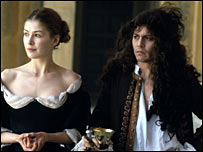
It's taken eight years to make The Libertine - and if it wasn't for the Isle of Man offering itself as a cheaper location - it may never have been produced. 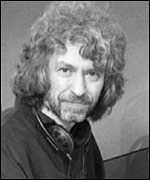 | | Stephen Jeffreys |
But it first began as a stage play in 1994. Writer Stephen Jeffreys - who has also written the screenplay - has a long pedigree as a playwright. One of his more recent plays, I Just Stopped By to See The Man (2000) enjoyed a three week run at the Octagon Theatre in Bolton. It starred stalwart of the Manchester theatre scene, actor Wyllie Longmore as a legendary Blues guitarist Jesse 'The Man' Davidson persuaded to come out of retirement by a young English musician called Carl. Richard Turner caught up with Stephen during the run to talk about I Just Stopped By.. and the forthcoming release of The Libertine: The Libertine – how did the film come about? "I wrote the play 12 years ago. We did it with Out of Joint theatre company and it seemed to do pretty well. Then a couple of American guys saw it in London and said they wanted to take it to America. So, it went on at the Steppenwolf in Chicago with John Malkovich in the lead. Then I was asked to write the screenplay for the film – and when someone asks you that, you don’t say no... 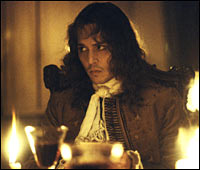 | | Oscar-winning? Johnny Depp |
It’s actually taken a very long time. The film was announced in 1998 and we didn’t start shooting until April 2004. Actually, the film was almost destroyed by changes to the tax laws until the Isle of Man stepped in and saved it. John Malkovich was filming on the Isle of Man at the time for a film called Colour Me Kubrick. They had a major funder drop out so it wasn’t made but the Manx government said we could film The Libertine there. So that’s what we did. They have different tax laws there and normally 50% of the filming has to be done on the island. But as we had to such a lot of building to do, it went ahead and we started the shoot in April 2004. And it’s out soon… "Yes, there’s been a lot of editing to do and it’s scheduled for a November release. Johnny Depp’s performance [as the Earl of Rochester] is Oscar-winning standard and I think it is the best performance he’s given. And if it’s going to be nominated for the Academy Awards, it’s got to be on in the US by the end of the year." As the writer of the screenplay, how closely do you work with the director? "It varies a lot. Some days I’m the least important person there, other days I’m right at the centre of things. Most of the time I have plenty to do because it’s a period production and I’m consulted when there are the slightest changes to the dialogue. I haven’t seen the most recent cut but there are only two or three things which I wish were different. And that’s pretty much down to Laurence [Dunmore, the director] because he’s involved me at every stage discussing the script." Why all the period productions? "I suppose I’m known as someone who can do historical writing – I don’t know why. I’m doing one now about Florence Nightingale and there are certain techniques I work with. But essentially, what we’re doing is forgery! You can’t ever reproduce exactly how Florence Nighingale or the Earl of Rochester actually spoke." Tell us about I Just Stopped By.... where does your love of the Blues come from? 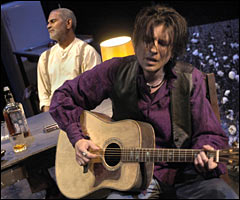 | | I Just Stopped By to See The Man |
"It was when I was in my early teenage years listening to people like The Beatles and The Stones talk about the roots of the music they played. Then John Lee Hooker did a tour of the country. It was music I knew nothing about at all but I realised it was the root of all the popular music I’d been listening to. It struck me as very odd that this music which had been formed in the cottonfields and places like LA - that that music over a period of 25 years had settled in the suburbs of Britain. And I liked the idea that a younger black generation had rejected that music. Their relationship changes: at first Jesse dismissed Carl. But when he hears them [Carl's band] playing on the radio, then he talks about them differently. It’s the way that music makes it acceptable and they have this great shared thing…" The play has only been produced a few times. Why? 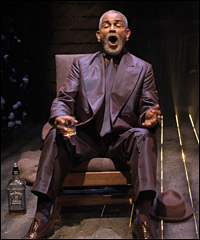 | | Wyllie Longmore: 'Wonderful performance' |
"Well, it’s had three productions in the US – in Chicago and LA – as well as at the Royal Court here five years ago. Basically, it’s not an easy play to do in this country. You have got to get a guy who can play quite an old black guy and who can sing. There are very few in this country and we were were very lucky to have Wyllie in this production. Black actors in the US don’t put on their CV that they can sing because they get cast in musicals! What's it like working with Wyllie? "I thought it was a wonderful performance. The thing about Wyllie is that he can deliver the low key moments and then stand up and talk in a Shakespearean voice. He’s got that dimension in his acting to move up a gear. It’s a difficult part to play but I think Wyllie got it just right." Do you prefer writing for stage or screen? "They are such different jobs but I like both of them and I like moving between them. But I suppose the experience of The Libertine has taught me that: it’s all very well doing a film but anything can happen with it and as a playwright, I’m much better off doing a play which I’ve got more control over." |