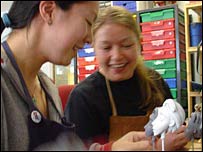
The first thing you notice is: how unnoticeable their place is. There’s no blue plaque on the wall saying: ‘Bob the Builder was born here.’ In fact, standing outside their Altrincham studio, you really wouldn’t know that dozens of household names began life here. 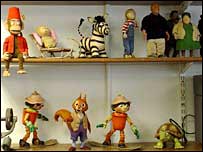 | | Some of the studio's puppets |
But step inside, and there’s no mistaking the love affair with ‘making puppets’ that persuaded Hollywood director Tim Burton to ask Ian Mackinnon and Peter Saunders to put flesh on the bones of his latest film, The Corpse Bride. The place is full of the best-known puppets around, from Noddy to Bob the Builder to Bill & Ben, More than that, a team more dedicated to their craft, you will not find. The staff here are talented, highly creative individuals who are single-minded to the point of perfectionism. Attention to detail is all: obsessives need only apply. From sketch to modelThere is a minimum of nine or ten procedures before an idea – or in the case of Corpse Bride, a sketch in Tim Burton’s notepad - becomes a model ready for the animation team. First, the design has to be agreed by everyone involved: designers, sculptors, film makers. Making the slightest change to that initial design - no matter how late in the day - can be one heck of a task. 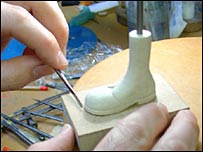 | | Feet of clay: making a model's boot |
Next: the figure is sculpted in modelling clay - frequently in ‘part-limb’ pieces - the part of the job which many at Mackinnnon & Saunders believe is the most difficult and important. The sculptors need a good working relationship with the designers to make certain they’re thinking alike. Then it’s mould-making time. The sculptor’s unique model is dismantled into individual body parts. By moulding each part, multiple versions of the same puppet can be created. This is crucial because there’s a lot of wear and tear during animation. At the same time, an armature is built. This is a jointed metal skeleton inside the model which is the key to bringing the puppet to life: to allow the model to be animated, even the puppet's tiny fingers must be able to move. 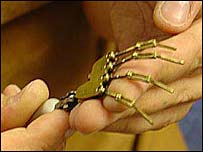 | | A puppet's armature |
The final stages are painting, costume and wig making (they call it ‘wigging’ at Alty’s mega model makers!). It really is the most meticulous work. ‘The Corpse Bride’ required 38 separate moulds just to make the one puppet. But you wouldn’t catch this bunch of modern day Gepettos moaning. As Ruth Curtis, one of the armature makers said: “Doing what you love and getting paid for it, is the best job in the world.” Therein lies the success of Mackinnon and Saunders. |