| 24 September 2014 |

| |
| BBC Homepage | | |
| |||
| Contact Us | | |
St Pancras InternationalYou are in: London > Travel > St Pancras International > 'The biggest project in history' 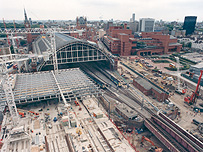 'The biggest project in history'St Pancras International is merely the 'jewel in the crown' of a much larger project called High Speed 1 that has been ten years in the making, cost close to £6bn and was the largest construction project in UK history. The finished result will be new international train stations at Stratford and Ebbsfleet, as well as the re-development of St Pancras. Just as important has been the laying of 109 km of new track that has connected, for the first time, Britain to Europe's high speed rail network, slashing journey times from London to the continent. It has been a massive effort that has involved digging tunnels underneath London, another one under the Thames, building a viaduct across the river Medway, moving 13 listed buildings and the relocation of wildlife habitats that would otherwise have been destroyed. Ben Ruse, of London & Continental Railways, the company behind High Speed 1, is justifiably proud of what has been achieved.  Graphic of the new St Pancras "St Pancras is the finest station the country has ever seen. The line that extends behind it is the first high speed rail track in the country. The tunnels dug down below are the biggest ever dug in London. A viaduct in Kent is the longest high speed railway bridge in the world." St Pancras InternationalOne reason why St Pancras was chosen to be the home of the new high-speed Eurostar service was because of its excellent transport links. It is right next door to King's Cross station, which serves routes to Newcastle and Edinburgh and also has six tube lines.
However, the station would need a £800m facelift for it to be a fit and proper place for international travellers to arrive and form their first impressions of London. The refurbishment work has included a 200 metre extension to the historic Barlow Shed so that the entire length of the Eurostar trains can fit inside. "It has been a very sensitive and faithful renovation. We've tried to keep the integrity of the building," Ben Ruse tells BBC London.
St Pancras International will actually be five stations in one: Eurostar, High Speed domestic services to Kent (from 2009), Midland Mainline, Thameslink and six London Underground lines at Kings Cross St Pancras. 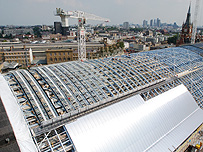 Roof of the Barlow Shed "While I hope that Barlow looks down with some satisfaction on what we are doing, by the same token, any engineer or visitor to this project will take their hat off to what Barlow achieved" says Ben Ruse. "It still fascinates people how he built that arch, even by modern standards. It was a spectacular achievement." The high speed journey to EuropeIf St Pancras International has been turned it into a fantastic destination, then even more work was needed to lay the new high-speed tracks leading in and out of the station and all the way down to the Channel Tunnel. 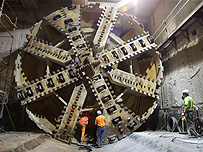 Photo: LCR/QA Photos Two minutes after leaving St Pancras, the train enters one of two new tunnels under central and East London that passes beneath 12 existing tunnels, 2,600 properties, four tube stations and 600 gas, water and sewage lines. Ten pumps were used to pump out millions of gallons of water, so that the giant tunneling machines could do their work. The earth beneath one stretch was so hard that it wore out six of the £10 million boring machines. When the train emerges from the London tunnel at Dagenham, a new base for the tracks had to be built above the soggy marshland. After clearing the marshland, two vital obstacles also needed to be overcome: The QE2 Bridge and the exit from the Dartford tunnel. Eventually, a line was threaded between the two obstacles through which the trains could pass, but it was tight. At one point the gap between the new railway and road is just 75 cm. After travelling east out of London and through the marshlands, the train will head into a three-mile tunnel to cross underneath the Thames. Upon exiting the Thames tunnel, the train can finally reach its top speed of 185 mph, the fastest in the UK. To cross the River Medway a 1.25 km bridge was built, the longest high-speed viaduct in the world when it was completed in 2003. It takes just 15 seconds for the train to cross. 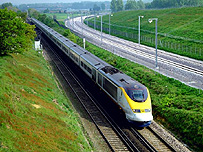 Speeding through Kent. Photo: PA When the train has crossed the Medway, there are just another 10 minutes before it reaches the Channel Tunnel, barely half an hour since it left St Pancras. Along the way it was gone through 20 miles of tunnels, crossed 150 bridges and three major viaducts.
On the other side of the Channel Tunnel lies 2,300 miles of Europe's high speed rail network that stretches from France to Spain, from The Netherlands to Germany. Britain, the home of the world's first railways, has finally joined the high speed club. It is a new golden age of rail travel. last updated: 15/11/07 SEE ALSOYou are in: London > Travel > St Pancras International > 'The biggest project in history' |
| | About the BBC | Help | Terms of Use | Privacy & Cookies Policy |