 | 28 October 2014 |

| |
| BBC Homepage | | |
| |||
| Contact Us | | |
MemoryshareYou are in: London > Memoryshare > The Great Storm: 'Why didn't anyone warn us?' 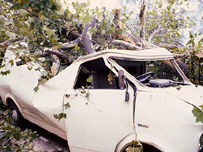 The Great Storm: 'Why didn't anyone warn us?'BBC London's Peter Cockroft recalls the Great Storm in 1987, finds out the extent of the damage at Kew Gardens and asks how the weather forecasters could have got it so wrong... Watch Peter Cockroft's video reports Audio and Video links on this page require Realplayer by Peter Cockroft"You chaps where a fat lot of good last night...." This was Michael Buerk's opening remark to Meteorological Office forecaster and BBC Weatherman Ian McCaskill, the day after southeast England was devastated by the Great Storm of the 15/16 October 1987. London looked like it had been hit by "a bomb" and it had! It's the term we use in the weather business for a particularly nasty storm.  BBC London's Peter Cockroft During Thursday night the wind had blown at 40, 50, 60 miles per hour. Gusts had hit 76 miles an hour at Heathrow Airport, 94 miles an hour at The London Weather Centre and 108 miles per hour was recorded at the top of The Post Office Tower. Not surprisingly by Friday morning roofs had disappeared and chimneys collapsed. A thousand trees at Hampton Court and in Bushey Park lay like matchsticks. Parts of the rail and underground network had come to a standstill. Roads where blocked by debris and electricity supplies cut. The City and The Old Bailey were closed for business. The Great Storm at KewRay Townsend had slept through the mayhem. He hadn't turned on the radio or the television before cycling off to work. Ray is now the Arboretum Manager at Kew Gardens. He remembers the mounting trepidation as he pedalled across Richmond Park where cars were weaving their way around fallen trees. 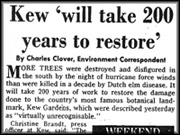 The Telegraph, Oct 87 "When I got here it was just unbelievable," says Ray. "Trees were just everywhere. We weren't allowed in for several hours... Many mature trees had gone over like dominoes... It was too dangerous for anyone to come into the garden." About a thousand trees had been damaged at Kew and of those 500 were lost completely. "I remember just walking through and thinking this can't be real. It's like your worst nightmare I can remember seeing trees down I'd known for years...Like old friends... That was the biggest shock and I still miss them today." But in the end it wasn't all bad news. "We lost a lot of mature trees but it has allowed us to plant up new trees." It also allowed the experts to get a good look at the roots of older trees. That has led to new planting techniques and ways of ensuring that the mature trees's root systems are kept in good order. So if a storm strikes again they should have a better chance of staying standing.
More than a breezeOn BBC One, the day before, Michael Fish had reassured the woman who phoned in that a hurricane was not on the way. Just hours before the storm struck Bill Giles was suggesting on BBC Two that it was only "going to be very breezy up through The Channel." Newspaper headlines on the following few days made grim reading for forecasters. WHY WEREN’T WE WARNED? Why had the forecast gone so wrong? The inquiry into the storm suggested the withdrawal of the weather ship in the Bay of Biscay had not helped. Observations from it would probably have forewarned the forecaster of the ferocity of the storm. 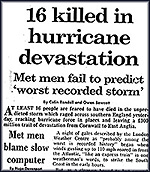 The Telegraph, Oct '87 Other weather reports from northern Europe had not been fed into the Meteorological Office's computer because of an industrial dispute in France. They would have made a big difference and contrary to the belief at the time – no other weather service had got it right! But perhaps the most important recommendation was that the Meteorological Office really did need to replace its rather old "number cruncher" with a modern super-computer. Could it happen again?It's a dangerous game to never say never. However in the intervening 20 years things have moved on considerably. Sophisticated satellite technology allows us to see what is going on out over the oceans in much more detail. Most of the world's weather services use "state of the art" computers to make predictions and they also compare forecasts. The "traffic light" warnings we use on television and radio are designed to make any impending danger more obvious to the public. And, of course, 24/7 media means you're only ever one click away from the latest, most up to date, forecast. The October 87 storm took 17 lives, miraculously only one person died in London. Statistically it was a 1 in 100 to 200 year event. But just 3 years later, on Burn's Day 1990, another fierce storm struck the UK. This time during the day, and this time 47 people lost their lives. Related Links: last updated: 15/10/07 You are in: London > Memoryshare > The Great Storm: 'Why didn't anyone warn us?' |
| | About the BBC | Help | Terms of Use | Privacy & Cookies Policy |
