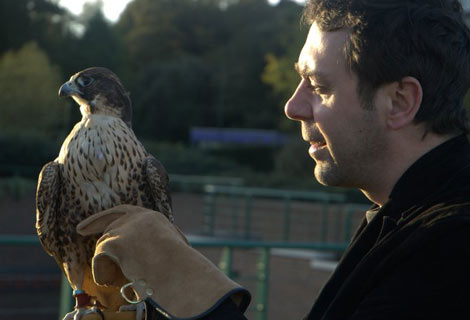
Sean Hughes with a Peregrine Falcon
Saving Planet Earth
7.30pm July 4th 2007
Believe it or not, Trafalgar Square once had real live lions roaring through it….Three million years ago.
Now of course, it’s all paved over and London’s a concrete jungle. Or is it? Comedian Sean Huges discovers the capital actually still has hidden refuges for wildlife. Unusual sanctuaries secrete some of the capital’s most endangered animals.
Sean begins his journey tracking down the fastest animal in the world, the Peregrine Falcon, which can reach a speed of 240 mph. There are only 1,500 pairs of peregrines in the UK.
They were nearly wiped out in England because of pesticides but in the last five years the birds have been spotted in the skies over the city and are now seen frequently at their roosting sites at the Millennium Dome, Battersea Power Station and the Tate Modern.
These buildings have replaced their traditional crag and cliff-ledge nesting sites and in the capital they feed on pigeons.
At the crack of dawn Sean travels to Battersea to meet falcon enthusiast Dave Morris Sean, who spends his spare time protecting the birds. A pair of Peregrines live on the chimneys at Battersea Power Station keeping an eye on the pigeons streaming in and out of the derelict building.
"These buildings have replaced the falcons' traditional crag and cliff-ledge nesting sites and in the capital they feed on pigeons"
They witness a falcon strike a pigeon. “Oh man this is cool” is Sean’s response: “There he goes he’s got the pigeon in his claws.” From Battersea it’s just a short hop to Wimbledon and Sean gets up closer to one of these birds. He gets to meet Calisto, one of the falcons flown at Wimbledon to scare the pigeons. Her job isn’t just confined to Wimbledon fortnight but throughout the year.
The RSPB run regular Peregrine spotting days to monitor how these wonderful birds are spreading across London. But they are at risk because they are very susceptible to slug pellets.
“So if you’re thinking of using slug pellets just be wary that these can really damage all sorts of birds including falcons – it’s your choice,” warns Sean.
The next endangered specie Sean meets is the exotic long eared bat. These vulnerable creatures are looked after at a London A and E – run by bat mad Jenny Clark.
“So why have they got such a bad reputation like people are frightened of them,” Sean asks Jenny. “I think people usually see a shadow flitting around in the dark. They don’t know what they’re like,” she says.
The bats nestle high in bat boxes which Jenny has put up especially in her garden. These creatures are highly nocturnal mammals more closely related to humans than to rodents.
Modern horror stories and the media haven’t helped their scary image but in fact they are harmless to humans and in Britain only eat small insects. Jenny puts out some mealworms for them everyday.
It is the loss of their natural roosting sites in trees and woodlands that have made them look inside buildings for places to roost. Bats are a really good indicator of how healthy the environment is so their decline should be of serious concern to us all.
Jenny provides emergency care and rehab for injured bats. Here, she describes her work:
It’s been said that you are never a yard away from a wild animal in London and the final species Sean goes to see is the otter. London’s otters were completely wiped out in the sixties and seventies by water pollution which killed the fish they survived on but 15 years ago they were introduced to the River Lee and now they are finding their way back to the city.
Otters spend most of their time out of the water and they need good access to the bank and they’ve got friends giving them a helping hand. Sean meets a groups of conservationists building homes for otters along the River Lee. As they are constantly on the move one otter can have up to 30 resting places in his territory.
In South London head Keeper Sam Johnson run a successful breeding programme for otters at the British Wildlife centre. Sean meets a pair, Oscar and Megan and is told that although he can feed them he is not allowed to stroke them.
“Because they look so cute you do want to pet them.” he says “But you know it’s just not a done thing. But they’re really sweet and beautiful and they look so majestic in the water. I didn’t realise until today that they prefer the land ‘cos if I could swim like that I’d be in the water all the time.”



 Three men are stabbed and two police officers are injured in a series of violent clashes at the Notting Hill carnival in west London.
 Listen to the latest bulletin
 Watch the latest edition(also in broadband)