 | 28 October 2014 |

| |
| BBC Homepage | | |
| |||
| Contact Us | | |
InterviewsYou are in: London > People > Interviews > London's Heritage Man 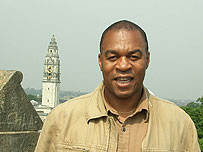 London's Heritage ManSir Christopher Wren's epitaph at St Paul's reads "Lector, si monumentum requiris, circumspice" – "Reader, if you seek his monument, look around you." The same could be said of our capital's heritage – if you are seeking it, look around you. Related LinksListen to clips of the interview
Help playing audio/video Now, one of the key figures in safeguarding our city's heritage will be broadcaster and journalist, Wesley Kerr, who has just been appointed chairman of the Heritage Lottery Fund's London Committee. Together with his colleagues, Mr Kerr will be in charge of distributing around £14 million every year to heritage projects in the capital. It is a role that takes him right back to his childhood. "It is everybody's heritage, that is the key thing to remember. I think that has always struck me ever since I was a kid," Mr Kerr tells BBC London at the Heritage Lottery Fund's HQ just off Sloane Square. "I was born in London, in Perivale, but I was conceived in Jamaica. For various reasons my mum couldn't look after me and I was fostered to white foster parents in the late 1950s. They were Edwardians. They were very interested in the past. The house was full of history books that I read voraciously. We lived in Ashford, halfway between Windsor Castle and Hampton Court. And at weekends we would go to picnic at Windsor Castle, this was in the 60s when there was no admission charge. Or at Bushey Park to look at the deer. Or swim in the Thames at Chertsey." "I was really brought up to love the heritage and to think that, even though I was from an ethnic minority, it was still mine." Mr Kerr, who read History at Trinity College, Cambridge, is passionate that everyone should have the opportunities to enjoy London's heritage as he did when he was a child. And that heritage can also be a great way for London's diverse communities to come together. "If we are to live together in this city as a community - which we do pretty successfully, considering the 300 languages that are spoken in our schools and just how divergent the origins of people are and how broad the spectrum of wealth - we've got to have spaces the community can come together and meet on equal terms. Be they public parks, free museums, libraries, places of worship or educational facilities. These are all things that the Heritage Lottery Fund is about and they are all things that bind society together."
"This is a city which has constantly been reconditioned. So heritage is about the present, but it is also about the future. It's about people as yet unborn because they will want to know about things that happened in the city before they were here. History constantly comes alive and that is why the Heritage Lottery Fund is important." The HLFThe Heritage Lottery Fund was set up in 1994 to give grants to a wide range of heritage projects in the UK. As the name implies, it is funded by the National Lottery – 28p of every pound is split between good causes such as sport, arts, charities and heritage. Around £800m, of the £4 billion that the Heritage Lottery Fund has distributed since 1994, has gone directly to projects in London. As an example of the difference that the Heritage Lottery Fund can make, the recently re-opened Royal Festival Hall was the beneficiary of a £22 million grant. Decisions for grants of over £5 million are made by the board of Trustees, but grants between £50,000 and £2 million are delegated to regional committees, which is where Mr Kerr’s London committee comes in. This year the London committee will be distributing around £14 million to various projects around the capital. The 2012 GamesInevitably, if you name any issue in London – construction, transport, council tax, or logos - the spectre of the Olympic Games will be raised and heritage is no different. "The games are already impacting on our funding. In London it will be £15 million last year compared to £14.4 million this year, and then £12 million within a couple of years. But of course, Londoners, especially in a couple of the boroughs, are going to benefit from the Olympics. So you could argue we are robbing Peter to pay Paul," says Mr Kerr. "There will certainly be long-term regenerative benefits for certain boroughs, although you could argue that this is an expensive way of doing this." "It's wonderful that we have the Games - it confirms once again that London is the greatest city in the world. But there has to be a lasting benefit, other than a few stadiums and I hope that the permanent buildings will be good ones and add to our heritage." Not a role-modelMr Kerr says that when he was awarded a scholarship he was probably the first black pupil to ever attend Winchester College. In 1985 he was the first ever black TV news reporter for the BBC, where he would go on to be a Washington and Royal Correspondent. As the first black chairman of the London Committee at the Heritage Lottery Fund, how conscious is he of being a trailblazer? "I think we're all just ourselves. We're not necessarily carrying a banner, we're just trying to do the best we can for ourselves. If I am an example to other people to work hard, to succeed, and to shape our society positively, then that is terrific. But I don't see myself as a role model." "I don't think there is a ceiling for ethnic minorities in this country. I think for a black person born now in this country anything is possible. It is perfectly possible to have a non-white person to be Prime Minister one day." "It would be nice if more of the major museums in London had more non-white managers, but I don't think it is a glass ceiling. It might be an issue of confidence and people needing to put their names forward. It would be quite nice if the BBC had some non-white people on its board of management!" Despite this small slight on the corporation, Mr Kerr will continue working for the BBC on a freelance basis, while he juggles his role as Chairman. The committee meets four times a year, it is unpaid, and involves two days work every month, although he stresses that it also means lots of site visits. "One ambition while I am chairing the committee is that all people in the 33 boroughs will be within a walk, cycle or bus ride away from a HLF funded project that they can enjoy." "Heritage has the potential to transform people’s lives and transform their imagination and their outlook. Without understanding the past, you cannot understand the present and you have no map for the future." last updated: 15/05/2008 at 12:40 SEE ALSOYou are in: London > People > Interviews > London's Heritage Man
|
| | About the BBC | Help | Terms of Use | Privacy & Cookies Policy |



 Listen to the