 | 24 September 2014 |

| |
| BBC Homepage | | |
| |||
| Contact Us | | |
London LifeYou are in: London > Features > My London > London Life > Dying for an answer  Dying for an answerKurt Barling investigates the assumption that gun and knife crime is being caused by a distinctive black culture and asks if this view is missing the point The Prime Minister caused a storm of protest last week when he appeared to suggest that Black Communities should do more to denounce the extreme violence that is killing many young black men. February was a busy month this year for the capital’s killers. But what has shocked Londoners most is the age of the victims. The deaths of three teenagers sparked an outcry and a search for whom to blame. 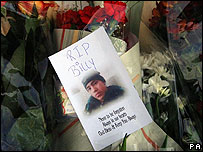 Billy Cox Memorial On the 3rd 16-year-old James Andre Smartt-Ford was shot twice at the Streatham ice arena in front of hundreds of revellers. Michael Dosunmu, 15, was shot dead by gunmen who broke into his home in Peckham on the 6th. Billy Cox, also 15, was shot in his parents flat in Clapham on Valentine’s Day. By the 22nd a hastily convened gun crime “summit” took place at No 10 Downing Street under the stewardship of the Home Secretary, Dr John Reid and the Prime Minister. It was seen as a high level response to a terrible catalogue of tragedies. At the meeting were a host of community activists who have worked tirelessly over the past decade to impact on a rising tide of extreme violence being visited on certain parts of the capital’s impoverished and troubled communities. Some individuals like Lucy Cope, who set up Mothers against Guns after her son Damian was gunned down in 2002, refused to attend. Curiously enough when Billy Cox was murdered he was again characterised as a black victim. His mother is Thai and his father English but that has been mysteriously overlooked in reporting his shooting. Close to the flat where Billy was shot, some pretty sophisticated street art has been painted on to several walls to commemorate his short life. On the same day in February as the Downing Street “Summit”, thousands of people, overwhelmingly Black Londoners rallied in Trafalgar Square asking for recognition of the vulnerability of young black men to gun and knife crime, but also for more tangible support in tackling it. It seems a bit of an oversight then on the Prime Minister’s part to specifically call on Black people to denounce the killers, as if somehow only black communities are responsible for producing them. These young people are not socialised in their early years in some system of apartheid but, in London, with their peers from other ethnic groups. There may be many reasons why young men are killing each other on the capital’s streets but it is hard to identify specific cultural attributes which can be ascribed to particular ethnic groups. Certainly criminality, above all associated with illicit drugs plays a part. The break down of families is a feature, particularly where young men have no responsible father figure. These conditions are present amongst a broad range of vulnerable young men and women who in the main live in poor urban communities. They do not come exclusively from any ethnic group, even if there is a strong representation in certain boroughs of particular ones. The single most important institution within Black communities which provides an alternative cultural outlook is the church. Not so much the established Church of England but the independent Evangelical Churches, of which there are many hundred across the capital. They have ventured onto the streets with street pastors to challenge attitudes, provided venues for people to talk openly about the issues they face, even engaged those characters who’ve turned away from criminality to offer guidance to those still in trouble. The irony is the young killers and their victims do not necessarily come from families with a criminal past. Jason Fearon who was shot dead outside the Turnmills nightclub in Islington at Easter 2003 came from a family of estate agents and professionals. There is a growing sense that an absence of viable father figures for many of these young men plays a powerful role in shaping their attitudes. When Ashley Walters emerged from his spell in prison two years ago I interviewed him and he gave what I thought was a telling insight into the mind of some of these young men. 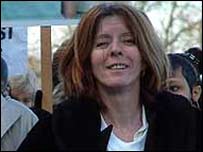 Lucy Cope - Mothers Against Guns Walters said that the absence of father figures often means the young men make up their own composite images of what constitutes manhood. These characterisations of manhood don’t come from practical experience past down the generations but from perceptions gained mostly from the media; music, computer games, film, street culture all have their parts to play. But let’s return to the search for support that took the Reverend Nims Obunge and his fellow activists in the struggle against violence in London’s vulnerable communities to Downing Street. Obunge told BBC London that his conversation with the Prime Minister at the February “summit” appears to have been misinterpreted. More legislation rather than government spending in impoverished areas appears to be the immediate plan for the government. Obunge believes there needs to be more financial support but also more research targeted on finding answers to exactly what the causes of the violence are. Once this evidence is available he believes the government has a responsibility to financial support community organisations to tackle the problem. In reality it is very difficult to reach the minority of young men who are involved in this extreme violence once they are already on that path. One way or another they end up getting caught either by the law or each other. The real challenge is to identify what is leading them there. Then others might be diverted. Last week’s furore over the planned removal of the Mural to celebrate Billy Cox’s life offers another lesson. I talked to the friends of Billy who had “commissioned” the portrait of Billy from a respected local street artist. Whatever the rights and wrongs of this particular piece of street art, it reminds these young people (mostly “white”) of their vulnerability to street violence. The fact that the adult world was so eager to belittle the graffiti as vandalism says a lot to them about how much the adult world is listening to their fears and their way of expressing them. The issue remains how those working in impoverished and troubled communities can prevent more young boys embarking on a path which leads almost inexorably to an early death. There are clearly no easy answers. It is difficult to see how stigmatising the “black community”, when so much work has been done to de-stigmatise gun and knife crime as a “black” issue, will help. last updated: 11/12/2007 at 14:59 SEE ALSOYou are in: London > Features > My London > London Life > Dying for an answer [an error occurred while processing this directive] |
| | About the BBC | Help | Terms of Use | Privacy & Cookies Policy |
