 | 24 September 2014 |

| |
| BBC Homepage | | |
| |||
| Contact Us | | |
London PlacesYou are in: London > Places > London Places > Moving History 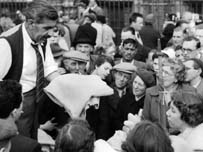 Photo by Eva Roman Moving HistoryKurt Barling The Mediatheque at the BFI Southbank has opened their vast archive to the public free of charge. BBC's Kurt Barling examines the treasures on offer. The BFI Southbank has embarked on a huge project to digitise the National Film and Television Archive. It’s hoping that this will firstly preserve rare and volatile footage for future generations and just as importantly make it accessible to a much wider audience. On 14th March the Mediatheque at the BFI Southbank will, with a mouse click, usher in a new worldview of London’s twentieth century history. It will give Londoners and other visitors the chance to get a closer look at the past. I say twentieth century, but there are a few glimpses of the late nineteenth century too. Rare archive like the 1896 moving images of commuters on Blackfriars Bridge will be immediately accessible. Queen Victoria’s jubilee celebrations in 1899 are also available. New PerspectiveGiving non specialists a chance to study the archive in this way should give a whole new perspective on the past. It will take film critique on to a new level as both academic and the interested amateur begin to interpret this material. 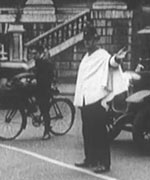 Photo by Eva Roman In the viewing the reward is in the detail. Take the 1896 Blackfriars Bridge footage. A young teenage boy crosses the Bridge presumably on his way to work. He’s reading a newspaper. Presumably the headline is something like Cecil Rhodes’ resignation as Premier of Cape Colony; or even the German Kaiser congratulating the Boers on recent victories – a prelude to the Boer War. The couple crossing the Bridge arm in arm. Both are wearing obligatory hats. There are hats everywhere. Obviously there’s not a combustion engine in sight, its all horse, cart and carriage and tons of manure for London gardens. The archive brings Victorian, but particularly Edwardian London back to life. Much of the early footage is shot by keen amateurs and it therefore concentrates on ordinary people and ordinary street scenes. It shows life in the raw. A tram ride along Ealing Broadway in 1901 reveals female strollers armed with parasols and long skirts. Not a sun-seeker in sight. Jane Lockley (aged 101) recalls an aunt who even when she went to the beach in summer kept gloves on and a parasol up. Keeping out of the sun was deemed to be healthy. A hundred years on despite the desire to appear tanned, once again concerns about the sun and health or on the agenda. A New MediumRobin Baker the curator of the Mediatheque has found inspiration in the fact that despite the differences over the past century, some aspects of London life remain essentially the same. Congestion is a case in point. London street scenes shot in 1903 show traffic chaos at Mansion House and on Fleet Street; a reminder that too much traffic in Central London is not an entirely modern phenomenon. As the twentieth century progresses its clear from the archive that public institutions begin to see the propaganda use of the new medium of film. Footage shot by local authorities and transport authorities highlight the advance in social housing and transport infrastructure. The BBC is still in the future and documentary filmmakers use this patronage to develop film techniques we are now familiar with. Southwark Council commissioned film makers to show the new housing being built for workers, parks and public amenities for children. Southwark’s residential streets are wide and tree-lined with only the odd motor cars to be seen. Of course within twenty years the Luftwaffe would make a mess of it but its clear the local authority is painting a picture of better times for the people. Piccadilly Line from 1928 shows the attention to detail of staff polishing the brass fittings. Albert Honey (aged 93) told me that this was precisely the sort of chore demanded of him when he joined the service in 1929. Albert eventually rose to be in charge of four tube lines. Diverse LondonShot in 1924, Cosmopolitan London reflects its times in different ways. Recognising the diversity of many districts of London it is blatantly judgemental in the way it portrays the Jewish and Chinese communities. The prevailing views of the time about people from the Empire inform the inter-titles (the captions on silent movies). I doubt whether you could actually show these today so outrageous are the prejudiced observations. One of the most startling films is the first colour film of the Thames. It is the remains of a colour test shot in 1934 as a journey down the Thames from Ham to the docks around Tilbury. London was still a busy port and the Thames was bustling. It’s a strange sensation watching a world in colour that we have only imagined in Black and White. In a curious way can remind a younger generation how older generations see the past in a less one dimensional way. Monochrome tends to flatten history. Petticoat LaneFor me one of the most outstanding bits of footage captures the vibrancy of the Jewish Market at Petticoat Lane in 1903. Again it’s the detail which offers explanation. The names on the shop fronts and trading stalls are mostly Jewish. The subjects of the film are all keen to be seen on camera. They stand around as if having a portrait taken unfamiliar with the new technology of moving pictures. Even though all the footage is obviously silent the place is packed full of characters. Watch Kurt Barling's films on the BFI's extensive archive
Help playing audio/video As well as noticing the rows and rows of people wearing hats the market, which is shoulder to shoulder busy, is dominated by the presence of men. Janet Armstrong (99) takes the view that this reflects the times, where men dominated public life. Certainly that is one of the most obvious changes in modern times. Public life is far richer for its diversity. When Dr Eva Roman took these stills photographs in the 1950s little had changed in the composition of the market over the intervening fifty years. “The traders gave much more than the goods and wares they offered”, she recalls, “everyone who stopped or even just glanced in passing got genuine friendly chatter and even if you didn’t buy anything, they still wished you well.” The pictures reflect London still in recovery after the devastation of the 1939-45 war. Interestingly although some hats are still being worn they are less prevalent than before the war; the shortages of materials and costs took the steam out of the milliner’s trade. Bennie Banks has worked Petticoat Lane for sixty years and high above Wentworth Street he points out the metal stalls that he still puts out for traders to use. Although until the early 1990s Petticoat Lane was predominantly Jewish, he believes the Jewish market is gone for good now. There are just four Jewish traders left and they are all close to retiring. It has struggled to attract shoppers as it used to and now Spitalfields market a few blocks away is a more varied place to stroll around on Sunday morning. The Mediatheque archive is of course about much more than old black and white footage. As the home of the National Film and Television archive, it comes right up to date with all manner of material which has been hidden away for a generation. The Mediatheque is free and opens to the public at the National Film Theatre from 14th March on London’s Southbank. last updated: 15/05/2008 at 11:40 Have Your SayYou are in: London > Places > London Places > Moving History
|
| | About the BBC | Help | Terms of Use | Privacy & Cookies Policy |



 Listen to the