 | 24 September 2014 |

| |
| BBC Homepage | | |
| |||
| Contact Us | | |
2012 FeaturesYou are in: London > 2012 Olympic Games > 2012 Features > Atlanta’s Olympic Legacy 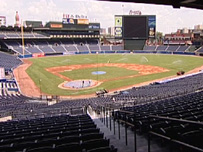 Atlanta's Olympic stadium Atlanta’s Olympic LegacyBBC London's Kurt Barling analyses what London can learn from Atlanta - the host of the 1996 Olympic Games The euphoria of winning the Olympic Games in 2012 has begun to ebb away. Now the real business of building the Olympic Park begins. The London bid promised a significant legacy for the capital and Mayor Ken Livingstone claims a good model for sustainability is Atlanta 1996. Atlanta 1996 doesn’t have the best of reputations. It was criticised for being too commercialised, there were problems with public transport links and during the Olympic celebrations a lone lunatic set off a bomb in Centennial Olympic Park which caused the deaths of two people. So it’s perhaps an unusual place for our own Mayor Ken Livingstone to be looking for Olympic inspiration. Sydney is the most celebrated spectacle of modern times and Barcelona certainly created a physical legacy in its Mediterranean makeover. What Atlanta does have in common with London is its ethnic diversity. The origins of that diversity may be rooted in slavery, but the historical division between haves and have nots is not dissimilar to the relationship between the East End and the rest of London. The Atlanta Committee for the Olympic Games (ACOG) for the 1996 Olympics was steered by the man who’s become known as the “Father” of the Atlanta event, Billy Payne. Whilst bidding for the Games, Billy Payne travelled the globe with Andrew Young. Young was a former US ambassador to the United Nations and a key confidente of Martin Luther King. Payne believes it was the unity and comradeship that they displayed which encouraged the International Olympic Committee to take their long shot bid seriously. Likewise, in London the diversity element in the 2012 bid was a key part of impressing the voting members of the IOC in Singapore. Surprisingly for a city whose Games have an ambiguous reputation; Atlanta appears to the outsider to revel in its Olympic City status. In the heart of the City you’d be hard pressed to travel a few blocks without being reminded of what happened here 10 years ago. The Olympic rings seem almost as ubiquitous as the flag of the state of Georgia. Although, unlike the plans at Stratford, the Olympic venues were not all in one location, they were in close proximity to Downtown Atlanta. The Olympic Stadium was reconstructed after the Olympic show moved on, to become the home of the Atlanta Braves baseball team. The odd shaped stadium in 1996 took account of the need for a baseball triangle. Turner Fields, as it is now known, was constructed with this alternative use in mind. From it you can still see the stand where Muhammed Ali (an Olympian in 1960), shaking from Parkinson’s, lit the Olympic flame. When I met Billy Payne at the aquatic centre, the venue for all the swimming and diving events in 1996, it became clear that the relationship between the building contractor and end-user at the early procurement phase was critical to creating a lasting legacy for Atlantans. The swimming pool remains. It has a moveable floor and bulkheads to alter the shallowness or length of the pool. Georgia Tech University which took over the management of the site before the Games had even begun reconstructed the facility in its wake. They added an extra floor to the building to include an indoor track and several basketball courts. These now provide a permanent location for the local clubs, schools and college sporting calendars. In fact on the day we were in town several hundred children were competing in a noisy under 9s competition in the Olympic pool. None of them were even born when Olympians were busy winning medals here. Interestingly the centre piece of Olympic development in the heart of the city came as a bit of an afterthought. In late 1993, Billy Payne suggested to ACOG that they should think about building an Olympic Centennial Park on a twenty one acre site in the heart of downtown. Most members thought that was a daft idea because downtown had a reputation for being the roughest part of town. Most people used to pass through with their car doors locked. 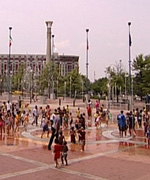 Olympic fountain in Atlanta Payne and Shirley Franklin pushed the idea through mid-stream and now take much of the credit for the most lasting legacy of the Games for the City of Atlanta. Both freely admit that neither truly envisaged the enormous consequences for regeneration that decision had. The Park just about gets away without being Olympic kitsch. The Olympic rings are everywhere and the French even paid for a centrepiece statue and memorial to Baron de Coubertin, the founder of the modern Olympic movement in 1886. There’s also a real regeneration lesson arising out of Centennial Park. A J Robinson was an architect responsible for a lot of the previous development in downtown Atlanta before, as he put it, he became part of the do-gooder brigade as Chief Executive of Central Atlanta Progress. He is now responsible for sustaining the regeneration downtown. He believes one of the hidden consequences of the Park is a genuine interest in people buying properties and locating businesses close to the centre of town. Mayor Franklin estimates a 10% shift in the urban population towards downtown since 1996. Although the rundown downtown was predominantly black, the new migrants are predominantly white and certainly well heeled. Not everyone is happy at this kind of gentrification but Robinson says that he foresees the Olympic legacy sustaining itself for at least another 15 years. He’s clearly a congenital optimist, but there is plenty of evidence in Atlanta to back up his faith. Mayor Franklin also came up with a fiscal arrangement which transfers 20% of the tax dollars generated by the regeneration of downtown into poorer districts like Vine City or English Avenue. These districts remain predominantly black but, according to Bob Jones who runs an economic development agency which services these two communities, these tax dollars are real. 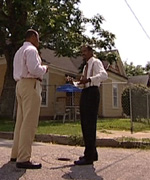 Bob Jones (l) talks to Kurt Barling In the past three years his development agency has funded a $30m low cost housing development from these tax dollars and he believes this is a concrete example of how the Olympics created what he calls a legacy of opportunity. Jones suggests that the Olympics of 1996 were an important moment in the Civil Rights education of Atlanta. The City was at the forefront of the political movement and now he ventures it’s at the heart of an economic revival fostered by mutual respect between communities. Certainly talking to volunteers like Jack and Shannon Grosko who were amongst the 50,000 who helped run events like the Marathon in 1996, there is a sense that more widely Atlantans attribute the transformation of their city to the Olympics. Jack says the best way for London to create a lasting legacy after 2012 is to get as many Londoners involved throughout the process of preparing for and then delivering the Games. Atlanta was best known for Civil Rights and the Civil War (think Gone with the Wind) before the Olympics but a few days ago it opened a new wing in its history museum dedicated to the Olympic Games. It clearly put Atlanta on the International map but as the exhibition recognises it has also given Atlantans an excuse to think big. Last month Mayor Franklin put together a private and public sector bid to preserve the official archive of Martin Luther King in Atlanta. She says this proves the Olympics has given the city the courage of its historic convictions. The archive was about to be put under the hammer at Sotheby’s and could have been broken up. Instead the City Great and the Good stepped in with a multi-million dollar offer. Offering London the benefit of their hindsight Payne and Franklin both advise the London organisers at LOCOG to remain flexible. The big lesson of Centennial Park is that a great idea may surface in 2009/10. They also point to the need to concentrate their efforts and not go promising all things to all men (and women). Last week the City of Atlanta hosted a massive outdoor party in Centennial Olympic Park to celebrate 10 years of Olympic legacy. Whilst internationally few people may recognise it, many Atlantans are quietly (and not so quietly) confident that they will still be reporting fresh legacies from the 1996 Olympics in another decade’s time. Perhaps Atlanta is not such an unhelpful model for Ken Livingstone after all. last updated: 19/05/2008 at 13:26 You are in: London > 2012 Olympic Games > 2012 Features > Atlanta’s Olympic Legacy
|
| | About the BBC | Help | Terms of Use | Privacy & Cookies Policy |



 Listen to the