| 24 September 2014 |

| |
| BBC Homepage | | |
| |||
| Contact Us | | |
I - ZYou are in: London > Faith > Communities > I - Z > Polish London 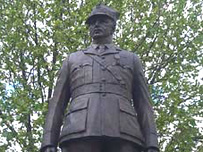 Poland's General Wladyslaw Sikorski Polish LondonFind out more about London's thriving Polish community - their history in the capital and how they continue to contribute to all aspects of life here.  Polish Flag Polish people have travelled to England throughout the centuries for a number of different reasons. In the 1500s Polish travellers came as traders and diplomats. In the 18th century a small number of Polish Protestants arrived as religious refugees due to the counter reformation in Poland. In 1940, with the fall of France, the exiled Polish president, prime minister, Polish Government, and at least 20,000 soldiers transferred to London. Central London now became the nerve centre for Polish liberation and its military headquarters. The Polish JourneyIn the 19th century, due to the collapse of the November Uprising of 1831, many Polish soldiers entered Britain in search of sanctuary. When the Second World War ended, a Communist government was installed in Poland, many Poles felt betrayed by their allies and were very reluctant to return home. Polish soldiers refused to return to Poland, and a considerable amount settled in London. At first the soldiers were housed in resettlement camps. The relaxation in travel restrictions to and from Poland saw a steady increase in immigration to Britain in the 1950s. Brixton, Earls Court and Lewisham were a few of the areas where they settled. As these communities grew, it was felt by the Polish Catholic hierarchy and the English and Scottish hierarchies that there was a need for Polish priests to settle and minister specifically to the spiritual needs of the Polish people. The first parish was in Brockley-Lewisham in 1951 and today there are 10 Polish parishes in London, in places such as Balham and Ealing. The Polish government in London was not dissolved until 1991, when a president was freely elected in Warsaw. The Polish people fought very hard to combat communism and for their right to liberty. London has been used very successfully by Poles, as a base to fight against the communist regime in Poland. Now that Poland has a democratic government, it is seen as an important base to help foster both business and political relations. 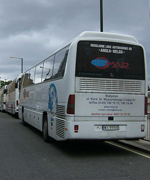 A parked Polish Coach in London The Polish Social and Cultural Centre (POSK) in King Street, Hammersmith, London was founded by and is central to the Polish Community. It was completed in 1974 and provides a strong focus point for Poles in London and works hard to develop their sense of social, cultural and national identity. More recently, London has seen a new wave of immigration of Polish people with the an estimated two million Poles having travelled to Britain since the borders opened in 2004. The Government admits to 204,000 Poles working here but that does not include those who have set up as self-employed or are employed in the black economy and are paid in cash. 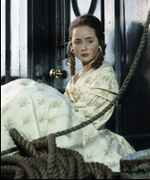 Lysette Anthony, as Florence Dombey Gay Low salaries in Poland (around £200 a month is not uncommon) are the primary reason why Polish citizens are drawn to working in the UK. Many migrant workers fill the gaps in the UK's labour market in such areas as hospitality, catering, hygiene and cleanliness, labouring and building. So many Londoners have employed a Polish worker for home improvements, knowing the costs will be lower, that the term 'Polish plumber' has become a current cliche. However the Polish community are making contributions to London life through film, media, literature and the arts. Lysette Anthony a film, television, and theatre actress is of Polish descent and Daniel Finkelstein, Comment Editor of The Times is also of Polish origin. In addition polish-language media are springing up to cater for the new arrivals. Radio Orla, is an internet radio station based in Ealing, which broadcasts primarily in Polish. 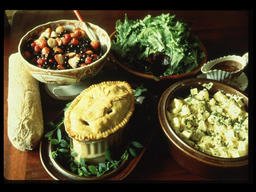 Polish dishes Polish restaurants are appearing more and more in the capital such as The Spitfire and Wodka. Some traditional Polish meat dishes are Bigos, an appetizing stew with various kinds of meats and sausages; Kotlet schabowy, a form of pork cutlet and Pierogi, which is a dumpling filled with meat, cheese, mushrooms or strawberries. 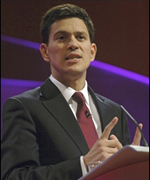 David Miliband, is of Polish descent Even politics has a Polish flavour in London. David Miliband and his brother and fellow cabinet member Ed, were both brought up in London and went to school in Chalk Farm, but they are of Polish stock on their father's side. last updated: 15/07/2008 at 15:32 SEE ALSOYou are in: London > Faith > Communities > I - Z > Polish London 
Podcast[an error occurred while processing this directive] |
| | About the BBC | Help | Terms of Use | Privacy & Cookies Policy |