 | 24 September 2014 |

| |
| BBC Homepage | | |
| |||
| Contact Us | | |
Crystal PalaceYou are in: London > History > Crystal Palace > Crystal Palace: A History 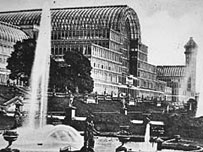 The Crystal Palace Crystal Palace: A HistoryBBC London's Gary Holland goes back to the year 1854 to find out all about the Palace and the people behind this amazing south London site The Crystal Palace was a huge glass and iron structure originally built in 1851 for the Great Exhibition held in London's Hyde Park. Prince Albert, head of the Society of Arts, had the idea of an exhibition to impress the world with Britain's industrial achievements. 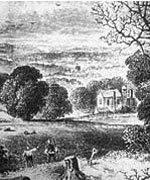 Penge Palace, Sydenham Countries including France, the United States, Russia, Turkey and Egypt all attended with exhibits falling into four main categories - Raw Materials, Machinery, Manufacturers and Fine Arts.
Penge Place, now called Crystal Palace Park, was owned by Paxton's friend and railway entrepreneur Leo Schuster. August 1852 saw the rebuilding work begin and in June 1854 Crystal Palace was re-opened in its new location by Queen Victoria. The whole building was enormous - 1,848 feet long and 408 feet wide including two huge towers and many fountains with over 11,000 jets rising into the air. 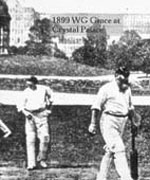 Cricketer WG Grace at the Palace in 1899 The palace and the grounds became the world's first theme park offering education, entertainment, a rollercoaster, cricket matches, and even 20 F.A. Cup Finals between 1895 -1914. The site attracted 2 million visitors a year and was also home to displays, festivals, music shows and over one hundred thousand soldiers during the First World War. Part of the gardens included a prehistoric swamp complete with models of dinosaurs. They were the first prehistoric animals ever built and came only around 30 years after dinosaurs were discovered. The dinosaur park has recently re-opened after a £4m refurbishment project.
Crystal Palace was cursed by bad luck and financial crisis. In 1861 the Palace was damaged by strong winds and on Sunday 30th December 1866 a fire broke out destroying the North End of the building along with many natural history exhibits.
Although the palace saw many successful years and millions of visitors financial problems plagued the Palace. Its sheer size meant it was impossible to maintain financially and it was declared bankrupt in 1911. A trust was set up and they soon employed Henry James Buckland as Manager of Crystal Palace. 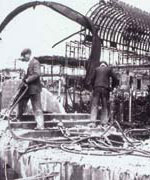 After the fire in 1936 'disaster'However, it was the night of 30th November 1936 that saw the most devastation. Henry Buckland and his daughter Crystal, named after his love of Crystal Palace, were out walking their dog and noticed a small fire at the Palace. This soon escalated and a huge fire broke out across the building. By morning most of the Palace was destroyed. There had been 88 fire engines, 438 officers, men from 4 fire brigades and 749 police officers on duty that historic night. Some of the original remains that can still be seen today are classed as Grade II* listed. They include terraces, sphinxes and the huge bust of Sir Joseph Paxton. Other fascinating features include sets of stairs, remains of the aquarium and the base of Isambard Kingdom Brunel's south water tower.  TALES FROM THE PALACES
A warm, funny and sometimes moving ten-part series filmed over a year with the conservation teams inside Britain's Historic Royal Palaces: Hampton Court, The Tower of London, Kensington Palace, The Banqueting House and Kew Palace. last updated: 09/04/2008 at 14:56 Have Your SayRichard Harcourt Amy Woollard S kerri Sheila Wilson siobhan kiran t.nutty Lesley barry puttock Andrew Maurice and Molly bennett(Morribees stained glass) Babino Julius Kimuli Andrew jack carolyn jack stimpson lisa Eloise Fleet Elizabeth Vineall Christine Laura Tuddenham Roy Mallinder Suzanne Nagle Christa Alsy emily moran SEE ALSOYou are in: London > History > Crystal Palace > Crystal Palace: A History
|
| | About the BBC | Help | Terms of Use | Privacy & Cookies Policy |



 Listen to the