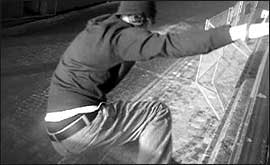
Kate met up with the founders of Lincoln's very own Parkour club to find out a little more about the sport, and what on earth possesses someone to want to throw themselves off a building. 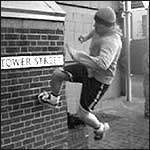 | | Approaching the wall |
Developed during the late 1980s in Lisse, France, Parkour, or Free-running as it is otherwise known, involves what can best be described as urban street acrobatics. The experts resemble something you might see in a comic or blockbuster film, their antics seeming almost super human as they "leap tall buildings in a single bound" and back-flip, roll and balance over any piece of "street furniture" available (that's benches, railings and walls to you and me). Le Parkour was first introduced to the UK in the BBC documentary "Rush Hour" and has since been featured in a host of television commercials and on Channel 4 in "Jump London" and "Jump Britain". Such programmes have seen interest in the sport soar to dizzying heights (much like the practitioners themselves), and its fair to say that the craze has now begun to take the UK by storm. 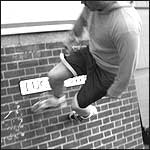 | | Along the wall |
Some of the latest recruits to the sport are a group of lads from Lincoln. The group started via the message boards at www.parkour.org.uK Interest from around the county has been growing and there is now talk of more organised meetings between free-runners from around the county. One of the things which has helped the sport's mass appeal is the ease of getting started. Aside from the necessity for protective padding for the more adventurous runner, no specialist equipment is required for Le Parkour. Potential free-runners, (or "Traceurs"), need to be aware of the risks involved and act safely; stretching, learning how to fall and roll correctly to minimise risk, and being aware of their own limitations. Practising in a controlled environment with crash mats, or on soft surfaces like grass is recommended. Runners also recommend not practising in confined spaces, (such as the living room sofa, so I'm told), as this tends to create greater opportunities for injury. 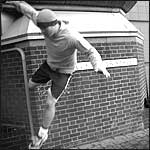 | | A perfect manoeuvre |
The recent documentary "Jump Britain" featured the sport's co-founder Sebastien Foucan with a host of free-runners from the UK, showing off their talent at landmarks across the UK; from Edinburgh Castle and the Forth Rail Bridge, to Cardiff's Millennium Stadium and London's South Bank. There are no plans for anything similar in Lincoln as yet. The lads feel they need a fair bit of practice before being able to match the skills of the likes of Foucan, who has been involved in the sport for almost 20 years. For now we will just have to watch this space. Thanks to Ed, Kirk, Fu and Scott for their help and involvement.
|