George Boole was born on 2nd November, 1815 on Silver Street, Lincoln. The house where he was brought up is now a solicitor's office. His father, John, was a shoemaker and consequently the family was not affluent. John Boole had a fine mind and a keen interest in science and mathematics. He shared this passion with his son and by an early age George was solving complex mathematical problems. Boole soon had a reputation as a child genius - and not only in the sciences. He soon surpassed his father's knowledge of Latin and a local bookseller became his tutor. By the age of 12 George was translating extensive Latin texts. 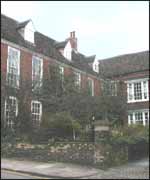 | | Boole's House in Pottergate, Lincoln |
His family did not have enough money for George to enter a grammar school and so he attended a school on Michaelgate. By the age of 16 Boole was assisting in the lessons and at 20 he had opened his own school and was supporting his family. George worked in various schools around the country and in 1849 he became a professor of Mathematics at Queen's College, Cork (later to become the University of Cork). He settled into life in Ireland and was well liked by colleagues and students. He stayed there until his death and in 1851 was made Dean of Science. George Boole's most important paper was published in 1854 and had the catchy title "An Investigation Into the Laws of Thought, on Which are Founded the Mathematical Theories of Logic and Probabilities". This was the paper in which he detailed the relationship between algebra and logic, and it is this study on which much of today's computer technology is based. His research and writing continued alongside his teaching and in 1857 he became a Fellow of the Royal Society. Boole died on 8th December, 1864. His health had been of concern for some time and he suffered from an hereditary lung disease. One November day he walked to school in the pouring rain and proceeded to teach in wet clothes. As a result he contracted a chest infection which ultimately turned into pneumonia. It has been suggested that his condition was made worse by his wife's attempts to help him. She subscribed to the widely held view that the cure should match the cause and so while Boole took to his bed, she threw buckets of cold water over him. A memorial to Boole can be seen in Lincoln Cathedral. The Teaching Window is dedicated to him and depicts his favourite passage from the Bible - the calling of Samuel. |