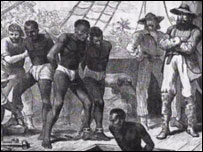
It's almost 200 years since the slave trade was abolished, but many young people only have little or no knowledge of what went on in the years running up to March 25 1807. BBC Radio Leicester's Everton Osbourne spoke to three young people, Zachias, Kiran and Tim, about how much they know about the slave trade and the impact that it has on their lives today…Zachias says that as a child he was called 'chocolate boy' by other children at school, and although this could just be a reference to the colour of his skin, he felt that it was linked to his being treated like a commodity, just as slaves were in the 18th and early 19th centuries. Other young people seemed less aware of the history of the slave trade though, with films like 'Roots' and 'Amistad' providing their only knowledge of it. BBC Radio Leicester's Nadine Thomas went out into Leicester City Centre to find out how much people know about the slave trade…One young person knew some facts about the slave trade as she'd attended black history classes as a child, but others said that they didn't know anything at all and suggested that it should be on the national curriculum. BBC Radio Leicester's Shirley Burgess spoke to African history expert, Wolde Selassie about how relevant the slave trade is to people in the UK today…Wolde says that echoes of the slave trade can be found in many aspects of modern day life. | "Education is a tool, and it is used as a tool to prevent aspiration and all the career opportunities that are available for people" | | Waldy Selassie, African history expert |
For example, he says that he has recently read in the news that young black boys are the most likely children to be excluded from schools. He then spoke about the laws in the 18th and 19th centuries that prevented slaves from becoming literate - if a white person was caught teaching a black person to read or write, they could face death by hanging or decapitation. Wolde thinks that the black boys being excluded from schools today is similar to the education being witheld from the slaves - both were being hindered from moving up the social and economic ladder: "Education is a tool, and it is used as a tool to prevent aspiration and all the career opportunities that are available for people." |