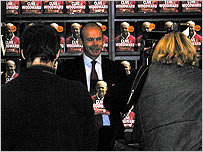
I joined the long queue at Market Street and within the half hour I was greeted with the customary warm welcome synonymous of Clive. It didn’t surprise me that he treated every customer with charm and interest. “I was talking to some of your old colleagues, who are now with BBC Radio Five, and we were reminiscing about my days in Leicester when your predecessor, Van Hopkins, with you as a summariser, formed Radio Leicester’s team,” was Sir Clive’s greeting. Clive Woodward’s name will, of course, last in the memory of many for his success with England, not every coach can boast a World Cup and Grand Slam title to his list of honours. However, for me, I have many other memories of Clive and his achievements. I distinctly remember Clive giving me my ever exclusive in 1984 on a Thursday night training session. I used to interview the players in the bar at the ramshackle “Nissan” hut. In the middle of my interview Clive blurted out into the microphone “I’m leaving for Australia tomorrow.”  | | Laughing all the way... |
Apart from his close friends and the Tigers coach Chalkie White, no one else knew. So I hotfooted it to Epic House to hand in the tape to the studio. The news was relayed immediately to the national radio stations. I didn’t have to buy a drink that evening – the management, for a change, looked after me. The first time I came across Clive was in the mid seventies when he was my opposing fly half in the Harlequins side. You never knew who was your opposite in the 'Quins set up from one year to another. Earl Kirton was one, a former All Black No. 10, who in 1974 was Clive’s coach at The Stoop. The next time our paths crossed was in 1978. I had just finished my playing career with Leicester and was asked by Radio Leicester to cover a game at Loughborough Colleges. When I arrived at the University I was greeted by their coach, Jim Greenwood. He in turn introduced me to his college captain Clive and I was immediately struck on the fine rapport they had for each other. Clive states in his book about Jim Greenwood that, “He opened my mind to the possibilities of the game and he planted the idea that to win against the best sides in the world you have to have a whole armoury of ways of playing.” That philosophy has clearly run through the England team in recent years. Woodward joined the Tigers after he left Loughborough and he entertained the Welford Road faithful in the early eighties. His partnership with Paul Dodge was a joy to watch in what were two contrasting styles. |