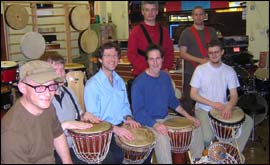
| How we came to this music Mark Taylor, who has been blind since birth, studied music at Dartington College of Arts and gained his Masters degree at Bretton Hall College. He appeared as a djembe soloist in a production of the 'Carnival Messiah' at the West Yorkshire Playhouse and plays regularly as percussionist and accordionist with 'The Durbervilles' . Steve Rivers studied drum and dance on five separate trips to West Africa. He runs a project aimed at beating stress through drumming and teaches in South Yorkshire. He has also formed the performance group 'Jumping Jubaloo'.
Andy Spearpoint is the ex lead singer of the 'New Fast Automatic Daffodils'.
He is now a freelance music teacher, specialising in African and World Percussion. He has also led community and amateur groups in Huddersfield and around Calderdale, and is a regular teacher at the Tasmin Little Music Centre at Bradford University Duncan Carmichael lectures at Craven College in Yorkshire, where he also leads the 'Craven Drummers' Ianto Thornber has been involved in African and Brazilian drumming since 1988, and teaching since 1996. He has made several trips to West and South Africa, and is author of 'The Djembe Guide' tuition pack. Iantho has trained with Lamin Jassey, Magatte Djeng, Claudio Kron, Seny Toure and Barak Schmool and In 1998 he formed Carabali. Where we play Recent performances have included the Grassington Arts Festival, Whitby Musicport World Music Festival, BBC Music Live, Dewsbury Arts Festival, the National Lottery Fynfest 2003 and the National Centre for Popular Music in Sheffield, We once followed Darius on stage in Millenium Square in Leeds ! Perhaps the most entertaining venue was playing for the opening of a new stone circle in a field outside Sheffield. The Songs Lamba and Soli are rhythms from Guinea, West Africa. Lamba is known as the moonlight dance, having connections to the full moon, and Soli is part of the Guinean circumcision cycle of rhythms. Mamady Keita says in his book: "three months before the circumcsion, they began to play soli, although not every day. During the week before the circucision, one heard it every day, and the night before, one heard it from the time of evening prayer until six o clock the next morning"
(Uschi Billmeier & Mamady Keita : 'A life for the Djembe')
.
|