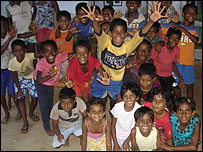
|  |  Six months after the tsunami I took a trip to Galle in southern Sri Lanka, a popular tourist resort that was one of the worst affected by the December 26 disaster. Here I found people were still struggling to survive in terrible conditions without homes or businesses and very little or no help from the government. Six months after the tsunami I took a trip to Galle in southern Sri Lanka, a popular tourist resort that was one of the worst affected by the December 26 disaster. Here I found people were still struggling to survive in terrible conditions without homes or businesses and very little or no help from the government.
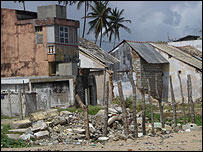 | | Devastation in Unawatuna Bay, on the south coast between Galle and Matara |
As you travel south from Colombo to Galle the devastation along the coastline becomes apparently worse. Many damaged houses are still standing precariously, looking like they could
collapse in the next breeze if they haven't already done so. The old railway still lies twisted by the side of the new one, a permanent
scar that reminds commuters of the day when so many lives were lost as people clambered on a passing train hoping they would be safe. Over 3,000 people were killed here.
In the city of Galle, huge walls built between the 13th and 15th century protect much of the old city, which is now a ghost towns with few tourists and a handful of western volunteers.
Waking along the road there are shells of boats on one side and tented camps on the other. One of the boats was only four days old when the tsunami came and smashed it against the rocks.
Now it is an eerie reminder.
The living conditions in the tents are quite unbearable and it is hotter inside than the humid tropical temperatures outside. A single bulb lights
the two sparse rooms separated by a flimsy sheet hanging from the central beam. For a family of four, it is a cramped space and sleeping is difficult with just one single bed. Three of the family have to sleep on the floor and this can be uncomfortable when the monsoon comes. The father is a fisherman who cannot move inland as the government is ordering because he needs to be by the sea to make a living and try to rebuild what life he had before.
In the evening I meet up with a Zimbabwean volunteer project and offer my assistance for the couple of days I am in the town and they immediately accept. We drove to a village just north of Galle where a man had donated his house to be used as a community centre and school. His generosity is greatly appreciated by the villagers and they see him as a hero.
The relief effort has been quite enhanced here in many ways and the help being offered now is community based, rather than just distribution of
necessities. We were to set up a screen and projector and put on a film for the children, although such an escapist relief attracted most of the camp. It is encouraging to see people are receiving this kind of help from non-government organisations and a refreshing boost to see the people so happy. If the government actually got on with its promises the story would be the same on the rest of the island. But, as it is, the unfair
distribution is causing unrest between the Tamils and Sinhalese with mass demonstrations and threats of an end to the cease fire. We find out in 10 days if there will be trouble as the Tamils have threatened to send a convoy to the parliament district of Colombo. No need to panic though, I am living in the south of the city at the moment, far enough away not to have to worry. |