The rise and rise of the labiodental approximant
By Dr David
In a famous study of Norwich English in the early 1970s, Britain's leading sociolinguist Peter Trudgill noticed something odd about the pronunciation of "r".
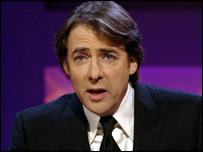
A surprisingly high proportion of children interviewed, right across the social spectrum, were using the form now famously associated with Jonathan Ross, rather than the more familiar apical variant of their parents.
If these findings were replicated elsewhere, he suggested, then this might mark the beginning of a change in progress. This pronunciation is technically known as a labiodental approximant.
TRY THIS AT HOME
Try putting your bottom lip (labio-) near to your top teeth (dental), but not quite touching (approximant), and attempt to produce a v, and you're making the sound many of us currently use in road, right etc. |
While we can't be sure why this sound has caught on over the last 30 or so years, we do know (a) that it's spreading like wildfire (it's now said to be the majority pronunciation among the young in some English towns), and (b) that it was originally associated with the South East.
Once the preserve of a privileged élite, it is now the 'classless' pronunciation of Jonathan Ross, David Bellamy and even Derek Jameson. People who pronounce their r's in this way are often thought to have a speech impediment. This assumption is quite wrong, and probably stems from the fact that young children often have difficulties with r and produce w (actually quite a different sound) in words like rabbit.
Labiodental approximant users generally have no problem pronouncing other consonants, nor do they necessarily use this r variant 100 per cent of the time.
There's not a shred of evidence to suggest that an epidemic of speech difficulties has gripped the country in the space of three decades, but quite a lot to suggest that labiodental approximant users make up an ever more significant proportion of the English population.
So, the next time you're tempted to mock the way Jonathan Ross pronounces his own surname, bear in mind that he and others like him seem to be leading an important change in English. It's not impossible that, in 100 years' time, we'll all be labiodental approximant users!
Find out more about Dr David Hornsby |