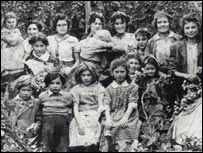
Heather describes herself:   I am a college junior at a university in Virginia, majoring in Social Work. My interests are primarily in child welfare, international social work, and social policy. The course is Social Work Methods and Interventions, discussing methods for social work practice, focusing particularly on working with and understanding a diverse population of clients I am a college junior at a university in Virginia, majoring in Social Work. My interests are primarily in child welfare, international social work, and social policy. The course is Social Work Methods and Interventions, discussing methods for social work practice, focusing particularly on working with and understanding a diverse population of clients
"Since their entry into Europe, the Roma have been outlawed, enslaved, hunted, tortured, and murdered"
(www.geocities.com/Paris/5121/timeline.htm, The Patrin Web Journal). While the condition of Gypsies living in Romania is not a highly publicized issue in the United States, spending several days visiting Gypsy villages in Romania opened up my eyes to this population. The residents of Romania who I was staying with compared the current conditions of the Gypsies residing in Romania, or Roma as they are known, to the conditions of African Americans in America before the Civil Rights Movement. Because of the government and societal oppression of this people group, I believe it is an area in which social workers should be concerned. Social workers are the perfect candidates for advocating for the Roma because it will truly take a social change in the nation for equal opportunities for this population. While the national Romanian consensus says there are only 400,000 Roma living in Romania, other sources estimate there are 1.4 to 2.5 million Roma in reality (http://www.pbs.org/frontlineworld/stories/romania/links.html, PBS Frontline World). While the intricate details of the history of the Roma are not all known, all sources agree that they are descendants of the country of India, part of the larger people group known as the Gypsies. All of the Gypsies that were brought over to Romania were brought over as slaves. Over time the Gypsies who resided in Romania became known as the Roma. In 1851 they were emancipated from slavery, however to this day they continue to be discriminated against by society. I thought the condition of the Roma would be a good topic to research; however I was skeptical of how much information I would actually find on the topic that would be documented in English, not Romanian. I can truly say I was shocked at the information I came across while doing my research. I did not realize the thousands of years of discrimination, abuse, and struggle that was behind the history of the Romani people. I still believe that social workers are the best candidates for the job of advocating for this misunderstood group, and promoting social change for the Roma. I must admit the task of researching ways to bring about change for the Roma is much more complicated and deep-rooted than I realized or expected. I was amazed that the Roma were brought to Romania as slaves and were freed only in the late 1800's, a fact that I, and most people I'm sure, were unaware of. I began to understand my Romanian host's comparison of the Roma struggle to the African-American struggle. In 1938 there are records of "Gypsy Clean-Up Week" in European countries, where the Gypsy people were taken out of their homes and beaten, in some cases murdered. The most shocking information that I uncovered was that half a million Roma were murdered in the Holocaust. While I could not find much information as to what the role of social workers was in working with this population, there are many international aid groups who are dedicated to serving this population, such as Amnesty International. There are also many NGO's and religious organizations involved in working with this population. Shocking to me was the content of the information on the current living conditions of the Roma. They are truly an oppressed people group, not only in Romania but all over Europe. One of the most disturbing facts that I learned from my research was the practice of signs hung near the entrance of shops and restaurants that state: "No dogs or Gypsies admitted" or similar sayings such as "The management reserves the right to refuse service to Gypsies
". Today in Romania many Roma live in villages together. These villages are similar to a ghetto, some without running water or electricity. In some cases today, the government will have separate schools for those living in these poor village areas. These schools often will be very run-down, and do not hold as much educational opportunity as the other public schools. Although hospital care is free of charge in Romania, many Roma are refused service. Discrimination of the Roma people is said by many to exist on both a government and societal level; however the Romanian government does not have legally defined statutes which discriminate against the Roma people. Discrimination is seen in the way they are treated by police officers, law enforcement and Romanian society. Social workers in Romania have been so overwhelmed by the situation of the orphans in the country that they have had little opportunity to focus on other areas. Some social workers in Romania may have a prejudiced view of this population because of generational prejudices passed along, and therefore be reluctant to help this population. It seems as though the orphan population does correlate with the oppression of the Roma, as evidenced in the high number of babies of Roma descent who are in government institutions as orphans. Perhaps if this group was not so oppressed they could better care for their own children, therefore helping with the large orphan population in Romania today. As the research of this social work student comes to a close, I can honestly say I was taken aback by the information I came across in my exploration of the Roma people. There are many people today who are as ignorant on the Gypsy people as I was before I began this research. I Now I have the choice of whether I can turn this paper in to my professor, hoping for a good grade and not worrying anymore about the facts I have learned. Or I can take this information and capitalize on any opportunities I have to advocate for the Roma population. Now that you have read this information, I leave this challenge to you as well. | 



 The Romani people: Heather's paper