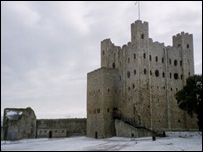
Audio tour: small charge Location: Rochester Castle is located in the city centre, off Castle Hill. 29 miles east of London on the A207-A226-A2, beside Rochester Bridge (A2) Facilities: toilets, gift shop
There has been a fortification at the important defensive site of Rochester since pre-Roman times. 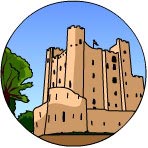 Under Emperor Claudius, the invading legions fought a major battle here in 43 AD, overcoming fierce resistance by staging an audacious river crossing and encircling the encamped local tribes. Despite this opposition, local governor Aulus Plautius described the people of Kent as the most civilised in Britain. This could perhaps have been a result of their proximity to Europe and important trade routes, and the subsequent mingling of culture and language. Under Emperor Claudius, the invading legions fought a major battle here in 43 AD, overcoming fierce resistance by staging an audacious river crossing and encircling the encamped local tribes. Despite this opposition, local governor Aulus Plautius described the people of Kent as the most civilised in Britain. This could perhaps have been a result of their proximity to Europe and important trade routes, and the subsequent mingling of culture and language.
In fact, the name 'Rochester' was derived by the Romans from 'Hroffe's Castre', which in turn was derived from the fortified house of a warrior chieftain, Hroffe, who once lived in the area. Castle facts: Rochester Castle is known as one of the preserved and finest examples of Norman architecture in England.
With its great keep, square and massive and one of the tallest in the country, made of stone, measuring 113 feet (35m) high, the tallest in England, and is 70 feet (22m) square. It is an excellent example of Norman military building.
The walls of the Castle are between 11 and 13 feet (3.5-4m) thick.
A circular staircase leads up to the battlements from which there is an astounding view of the Kent countryside. History: It was constructed by the Bishop of Rochester in around 1090 in the angle of the Roman town wall. The four-squared towers were added by Archbishop William de Corbell in 1127.
Rochester Castle was fortified against the King John and soon became a stronghold and headquarters for the rebels. King John lay siege to the castle in 1215 and took it after two long months. He finally undermined the south east tower and burned the props with the "fat of forty pigs" causing the tower to collapse.The city was well placed for raids on London and it also enabled them to devastate the lands of Kent, particularly those belonging to Lanfranc, Archbishop of Canterbury, who had crowned Rufus and was therefore Odo's and the rebels' enemy. 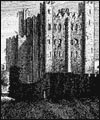 By the 17th century, the castle had become neglected, the keep had been burned out, and the site was being used as a local quarry for building materials. In 1870 the castle grounds were leased to the City of Rochester, who turned them into a public park and eventually, in the 20th century, responsibility for this imposing old structure was taken over by English Heritage. By the 17th century, the castle had become neglected, the keep had been burned out, and the site was being used as a local quarry for building materials. In 1870 the castle grounds were leased to the City of Rochester, who turned them into a public park and eventually, in the 20th century, responsibility for this imposing old structure was taken over by English Heritage.
Today, the castle stands as a proud reminder of the history surrounding the old town of Rochester, along with the cathedral, the cobbled streets and the Dickensian reflections.  More castles More castles
|