| 28 October 2014 |

| |
| BBC Homepage | | |
| |||
| Contact Us | | |
Action deskYou are in: Kent > BBC Radio Kent > Action desk > Joan's story 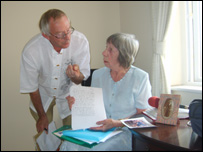 Joan and Frank going through her records Joan's storyBy Frank Hancock (NCH) Joan, now aged 84, was placed for adoption through NCH in 1927 and has accessed her adoption and birth records held in their archive. Joan was born in June 1923. She was placed for adoption in 1927 through NCH (known as “The National Children’s Home and Orphanage” at the time). It was only a year ago that Joan felt the time was right to access her records. Fortunately, NCH, one of the oldest adoption agencies, had a good record of Joan’s placement and her subsequent life. Joan’s NCH file, amazingly intact, tells us only a little of her birth family and her life with them. Registered at birth with the name Mildred, we know that she was born in Otley, Yorkshire, in June 1923 where her mother, Martha, living away from home, was a domestic servant. Martha had already had one child “out of wedlock”. Joan’s father was not named, but we know that by the time that Martha’s family helped place Joan for adoption through NCH, Martha was back living with her parents and her son in Kippax, Yorkshire. Joan’s birth grandfather was a miner, as were two of her birth uncles. A third birth uncle, Harold, was killed in action in The Somme in 1916 at the age of 21 years. Joan appears to have been “boarded out” with a Mrs. Harris in the village. 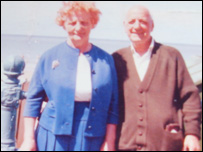 Joan's birth parents. We do not know if this was a relative or a friend. Martha received only half pay of nine shillings per week from the National Health Insurance Scheme, still known as “The Lloyd George Insurance Scheme” after it’s founder, clearly not enough to keep her first child and now Joan. Martha was described as having been an invalid for the last three years. Martha’s step-brother Granville, related by her mother’s earlier marriage, now took up Joan’s case. Granville was a member of the Weslyan Methodist Society and an authorised occasional Preacher. As a Methodist he would have known of the work of The National Children’s Home. It was Granville who completed the application form for admission of Joan to The National Children’s Home, for adoption. He bluntly responded to the question of Martha’s character with a simple “Rather bad”, but described Joan’s life thus far as a “tradjedy” (sic). Meanwhile, Joan’s adoptive parents, Horace and Kathleen were members of the Congregation Church, where Horace was a Life Deacon. They were living in Sittingbourne, Kent, and had applied to The National Children’s Home to adopt a girl, aged between three and four years of age “whose parents are both dead, if possible. Otherwise, one who came to the home through the death of the mother”. Kathleen felt that she could not manage a baby. From the brief information they were given of Joan, Horace and Kathleen said “Yes” to Joan’s placement with them. They were sent a tiny snip of a photograph of Joan holding a teddy bear. Kathleen and Horace had a seaside holiday planned for mid-July 1927 and encouraged by the idea that a holiday would take her mind off the ordeal of being placed for adoption, they asked for an early placement of Joan. Within a few weeks, Joan was on her way by train from Yorkshire accompanied by one of the NCH ordained “Sisters” and another child. After a few days en route in one of the NCH homes in Harpenden, Hertfordshire, Joan arrived at Sittingbourne station at 5-50pm on 21st July 1927, escorted by a Sister Bertha. There is nothing recorded of Joan’s last days with her birth family in Kippax, and she can recall nothing herself. Who said “Goodbye” and how? Perhaps Joan travelled with the Teddy we see in the photograph. Joan can remember nothing of the journey down or her brief stay in Harpenden. However, she can recall her first few days with her adoptive parents on holiday in Littlehampton. She never shed a tear after her arrival until she and her new family left to go on holiday, believing that she was being sent back home! Photographs on file show her with her new parents happily paddling in the sea. 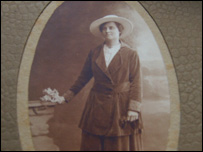 Joan's adoptive mother. Fortunately for Joan her adoptive parents took to her instantly. Who knows where she may have ended up had they not done taken to her. Rather poignantly the NCH application form completed be her step-uncle asked the question Joan, therefore, had nothing to fear of emigration to Canada, though in 1927, eighty years ago, her journey south to Kent was nevertheless a risky one. There do not appear to have been any contingency plans and had she been sent back by Horace and Kathleen she would almost certainly have spent more time in one of the NCH homes. She may never have found another adoptive family. After the holiday in Littlehampton, Joan settled well into her adoptive home and within a few months, after a kafuffle whilst the court and NCH unscrambled the mysteries of the new Adoption Act of 1926, Joan was duly adopted on Joan was the 16,155th child to be adopted in England and Wales. However, no adoption can have been more successful than Joan’s. Joan settled quickly and happily. She led a very secure and settled life. NCH always encouraged their adopters to keep in touch with NCH headquarters and Joan’s family was no exception. Joan’s adoptive parents wrote regularly to NCH Head Office in Highbury Park, keeping NCH in touch with Joan’s progress. In July 1938 Joan’s adoptive mother, Kathleen, wrote that Joan “often speaks of what she did when she was a “long way”, as she terms it, and can remember quite well us fetching her at the station, but she says that she never wants to go a “long way” again without her mummy and daddy, so that tells you everything” Help playing audio/video Kathleen and Horace continued to write of their “girlie”, as they called Joan, right up to July 1968, sending money and a newsletter of Joan to NCH each year. Joan also wrote regularly to NCH sending gifts for other NCH children. Joan duly went to High School, left at the age of 14 years to train as a shorthand typist at Commercial School. By November 1940 Kathleen was writing of enemy bombers flying over Sittingbourne on the way to London and of bombs dropping in Sittingbourne and of deaths, one of a two month old child. Joan was by now a Sunday School teacher and a voluntary nurse. In October 1942 Joan writes that “owing to the war I had to register like the other girls so I decided I would do nursing”, although she was legally too young. She was based in Queen Victoria Cottage Hospital in Tonbridge, Kent, until January 1945 after which she gave up her nursing career for the care of children with a disability. Joan feels that her adoption was all due to the hard work and good services of NCH, though she assures me that this in no way minimises the excellence of the life she had with her adoptive parents, where she says she received all the loving care any child could ask for. The BBC is not responsible for the content of external websites The last letter from her adoptive parents is dated July 1968. Joan was an only child in her adoptive family. She married but did not have children. She still leads an active life in Sittingbourne. Over the past year, with help from NCH and her friends, Joan has traced her birth family. After her adoption, her birth mother had gone on to marry and have other children. She has now met with her birth brothers , a birth sister, and many cousins. They knew nothing of Joan until she contacted them. She has been back to the village of her birth and to the NCH Home in Harpenden. last updated: 03/04/2008 at 11:49 SEE ALSOYou are in: Kent > BBC Radio Kent > Action desk > Joan's story |
| | About the BBC | Help | Terms of Use | Privacy & Cookies Policy |