| 13 November 2014 |

| |
| BBC Homepage | | |
| |||
| Contact Us | | |
Local HistoryYou are in: Kent > History > Local History > Chatham's Victory! 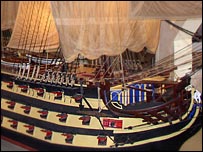 Chatham's Victory!In 1771, a 12 year-old Horatio Nelson arrived in Chatham, after a six hour coach journey from London. Both he and the dockyard were to play a crucial role in the Battle of Trafalgar in 1805. In 1771, a 12 year-old boy arrived in Chatham. The young Horatio Nelson had read in his local newspaper, that his uncle was the commander of the Royal Navy ship ‘Raisonable’, based at Chatham, and had decided that he would become a midshipman on the same vessel. When he reached the Medway, he was confronted by all the hustle and bustle of a busy working dockyard, with nobody there to greet him or show him to his uncle. He eventually established that the ship was moored out on the river, and was lucky to find some kindly sailors to row him out to it, thus beginning one of the most celebrated naval careers of all time. 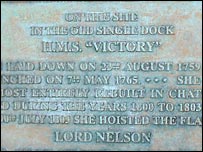 The site of the original dock Chatham dockyard at that time was a major naval port, with four dry docks – the same number as the whole of France! It was an important shipbuilding centre, as well as undertaking refits, and generally supplying and maintaining the fleet. On the 23rd July 1759, 12 years before the arrival of the young Nelson, the keel was laid for a new warship. It would take 2000 people six years to build. Its three gun decks would house over 100 cannons. The year of 1759 was known as the Year of Victories, with British successes in Quiberon Bay, Quebec, and the Seven Years’ war. The new ship was therefore named in honour of this – The Victory.
She was floated out of her dock in 1765, and by the time of Trafalgar in 1805 was an old ship. Indeed in the late 1700’s, she had lain moored in the Medway for several years, in semi-retirement, until being refitted between 1800 and 1803. The BattleOver these years, Nelson’s naval career had seen a steady rise to prominence resulting in him being made Commander of the Mediterranean. In 1805 he won his greatest victory against the French and Spanish fleets, at Trafalgar. He directed the battle from ‘The Victory’ and innovative tactics were applauded, as he broke the line and raked a French ship, killing over 400 enemy sailors. He then got locked with the ‘Redoubtable’, and one of the snipers shot down hitting Nelson. The bullet went through his shoulder and into his spine. He was taken to a lower deck, where he died four hours later. His body was placed head first into a barrel of brandy, to preserve it for the journey home. There is a popular myth that sailors bored through into the barrel, drinking the brandy they called ‘Nelson’s Blood’! He was landed at Sheerness docks, and then taken to Greenwich on board the ‘Chatham’ – the vessel owned by the commissioner of Chatham dockyard. 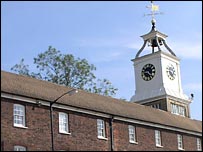 The dockyard has changed little since Nelson's day The Historic Dockyard ChathamVisitors to the dockyard today can still see much of what Nelson would have known. There is a plaque commemorating the place where ‘The Victory’ was built, and a large model of her, which was used in the 1938 film ‘That Hamilton Woman’. Around the 80 acre site are some 50 scheduled ancient monuments – historical buildings from the dockyard’s long history. The Mould Loft, on who’s floor the framework for ‘The Victory’ would have been drawn out, is now appropriately home to a new exhibition called ‘The Road to Trafalgar’, depicting the story of Chatham’s part in the great victory. Nearby is the site where the smithy’s would have made the giant anchors. The immense size and weight of these anchors (around 700 cwt) meant they could only be made in the spring or autumn. It was too hot for the smithies in the summer and too cold for the iron in the winter. The smithies were paid a good wage… plus eight pints of beer a day! The Ropery is an amazing sight, it is ¼ mile long, and when it was built in 1720, was the longest building in Europe. Nelson would also have checked his watch against the clock tower, and have been familiar with the impressive Admiralty buildings, which today houses offices, and the Commissioner’s House, that still stands as one of the most impressive pieces of naval architecture in the country. Find out moreThe BBC is not responsible for the content of external websites But most of all he would have known the River Medway, which flows majestically past the Chatham dockyard today, just as it did when he first arrived as a 12 year-old boy. Any visitor to the dockyard will be left in no doubt, that the success 200 years ago at Trafalgar, was in no small way also Chatham’s Victory. last updated: 25/03/2009 at 16:14 SEE ALSOYou are in: Kent > History > Local History > Chatham's Victory!    Kent's connection to slavery |
| | About the BBC | Help | Terms of Use | Privacy & Cookies Policy |