| 13 November 2014 |

| |
| BBC Homepage | | |
| |||
| Contact Us | | |
Jersey WondersYou are in: Jersey > Jersey Wonders > On the ale trail On the ale trailBy James McLachlan A whistle-stop tour of Jersey Brewery... 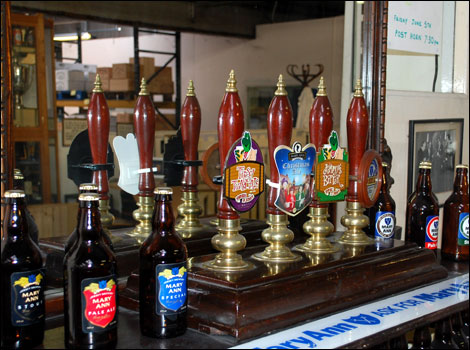 The ales of Jersey Brewery When I arrived in Jersey, one of the first things I noticed were a number of signs on the sides of various buildings instructing me to ask for Mary Ann. I admit now to being more than a little puzzled. Who was this mysterious woman? Why should I ask for her? And how could she afford to plaster her name all over the place? To my relief (and slight disappointment) Mary Ann did not turn out to be the highly successful lady of ill-repute I imagined. It was, of course, the name of the local ale, which has been keeping the pubs and bars of Jersey heaving for about 100 years. Dream jobBrewing beer is the sort of job people – mainly blokes – dream about. But for many of us it is something of a dark art. Keen to find out more, I met up with Jersey Brewery’s head brewer Paul Hurley, who gave me a crash course in beer production. He started by taking me through some of the key ingredients. 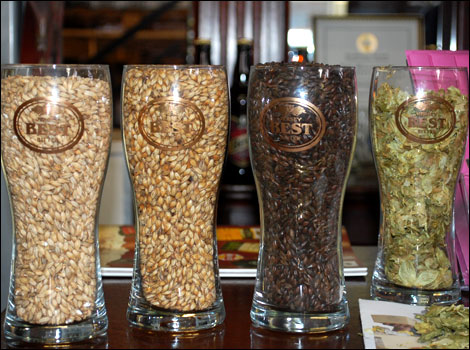 Malts and hops Mr Hurley said: “We use Marisota pale ale malt, the finest malting barley you can get. It is the basis for all our beer. We also use crystal malt, which gives reddish hues to you beer and a chocolate malt, which does exactly what it says on the tin. Then you have your hops. “Hops are wonderful things. They are the dried cone of the humulus lupulus plant. Only the female cone is of any use; the male is useless, so that is one up for the ladies in beer production. What we get from this is characteristic bitterness, and the resins it has give you aroma.” There is a gleam in Mr Hurley’s eye as we talk, and his passion for the job, which he has done for 25 years now, is clearly undimmed. We rapidly move on to the Mash Tun, where water is added to the malted barley at a controlled temperature. It stands for about an hour, taking on the look of a large, and not altogether appetising, bowl of porridge. The Mash Tun“The starch-rich grain contains a number of enzymes that are reactivated by the water. Those enzymes break down the starch into sugars and it is those that we want to extract,” Mr Hurley explains. “After an hour we ‘sparge’ or spray hot liquor all over the top of it and leech through all the goodness.” 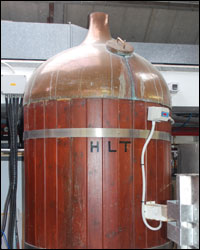 Jersey Brewery copper Ten barrels of the sugar solution called ‘wurt’, are added into the ‘copper’ – a large wooden drum with a brass pipe attached to the top of it. “The hops are then added to give you your characteristic bitterness and your aroma. We boil up in there for around about an hour, hour and a half. That extracts a lot of the bitterness and the aroma, it also adds colour to the product and sterilises it,” Mr Hurley says. Beery doomOnce the goodness has been extracted from the malt and hops the brew is cooled and transferred into a cavernous fermenter, which holds roughly 12,000 pints. As we peer into the bubbling tank, Mr Hurley explains what is going on: “What you see is around about six feet of yeast head. All our beers here are what you call top-fermentation ale. You put the yeast in with the sugar solution and the wurt and it starts to ferment into alcohol. The yeast rises to the top and we skim that off into a yeast vessel, which will be used for brewing with next week.” 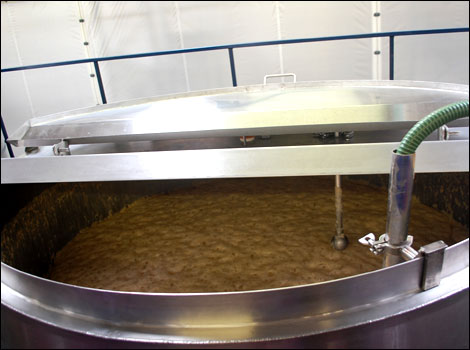 Fermentation The by-product given off is carbon dioxide, lending the fermentation area a pungent whiff. The concoction is more recognisable as beer at this stage and it is tempting to just dive in and start lapping it up. However, Mr Hurley wryly points out this would be tantamount to suicide as the whole top layer of the beer is devoid of oxygen. After letting it cool down over a 48-72 hour period, the beer is then held in cooling tanks at just under zero. The idea being, the cooler you can keep beer to once it has gone through the fermentation process, the better it will keep in the pub. Keg it“Welcome to the bridge of the Starship Enterprise,” Mr Hurley beams and it’s easy to see what he means. The kegging machine in front of me is controlled by a baffling array of knobs and dials, allowing the two lanes to process 75 eleven gallon kegs an hour. “The kegs go through a series of cleaning and sterilisation processes. We then put gas into the keg and back fill against that gas for a nice steady fill. It then goes past a weighing machine to make sure we put the correct amount in and gets put onto pallets ready to go out to trade,” Mr Hurley says. 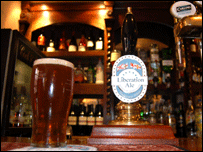 Liberation Ale The finished productThe end result of these processes is three very different looking and tasting ales: Liberation Ale, Special and Best Bitter. “Our cask-condition ale is Liberation Ale. It is very light and fruity,” Mr Hurley enthuses. “Our keg product is the Special, which is slightly darker. The Best Bitter is by far our best selling brand. It has got chocolaty aromas, a little bit of almost coffee notes on it.” “The beers all go through exactly the same processes, but with different raw materials and slight idiosyncrasies of what hops you add they come out as three unique products.” So is beer-making a dream job? It is a question that hardly needs asking. “I think I have described myself as the luckiest man I know, and I have no reason to change that now, even after 25 years,” Mr Hurley smiles. last updated: 19/06/2009 at 17:38 Have Your SaySEE ALSOYou are in: Jersey > Jersey Wonders > On the ale trail  |
| | About the BBC | Help | Terms of Use | Privacy & Cookies Policy |