| 13 November 2014 |

| |
| BBC Homepage | | |
| |||
| Contact Us | | |
Jersey WondersYou are in: Jersey > Jersey Wonders > Stone-age trade 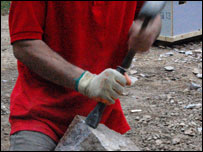 Stone-age tradeBy James McLachlan How the granite formed over 400 million years ago has provided homes and livelyhoods for generations of islanders. Since ancient times, man has used the natural environment to enhance his chances of survival. To combat a hostile world, stone-age men and women hewed primitive tools and shelters from the cooling lava that surrounded them. These primitive skills evolved into the intricate craft of stonemasonry that is still with us today. Nowhere is it more apparent than in Jersey. Take a stroll through the country lanes and you will be struck by sheer number of granite houses, churches and walls. Little wonder then that the phone book is teaming with stonemasons offering their expertise. But how did the granite, so intrinsic to Jersey’s built environment, get here in the first place? 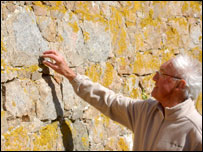 Ralph Nichols inspecting Jersey granite Cooling earth's crustGeologist Ralph Nichols explained: “The granites are made up of large crystals of three main minerals – quartz, feldspar and mica. “The crystals are quite large, so we assume the granite was formed by cooling slowly, deeper down in the earth’s crust near the base and has been intruded into the overlying rock of the crust. “The overlying rock has been eroded completely, so now we see a picture of what it was like at the base of the crust about 400 million years ago,” he said. It is the remarkable molecular constitution of Jersey’s granite that has made it a building stone par excellence, according to Mr Nichols. He said: “It fractures in three different ways, three directions at right angles to one another. One horizontally and two vertically at 90 degrees to one another. In essence, you have got a ready-made rock mass with lots of cuboid masses of rock in it that could be ideal for building.” 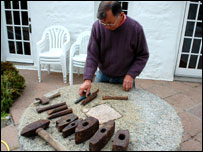 Mr Benest with the tools of the trade Mont MadoGranite has been quarried in Jersey for hundreds of years and in various different parts of the island. One quarry in particular produced granite so special it has taken on an almost mythical status – the stunning pink stone from Mont Mado in St John. Customers still ask for it and masons still want to work with it. The fact the quarry closed decades ago only adds to its allure. Retired stonemason Tony Benest spent most of his adult life cutting, splitting, heaving and building with granite. He described Mont Mado as ‘the best granite ever’. “Granite from Mont Mado varied in colour from a pinkish-grey right the way through to a red. Not just the rose pink. There was one section there when they actually had red granite,” he enthused. “I remember going up there in about 1959 and it was almost like being on another planet. You had quarry faces of different colours to your right and quarry faces of different colours to your left.” Old timeyMr Benest plied his trade with old-fashioned steel chisels and he believes a mason could get a better feel for the stone with these than the modern tungsten tools of today. 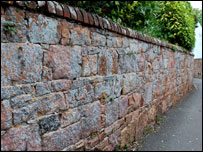 Mont Mado stone wall He said: “We used fire-sharpened steel tools in the old days, which were better. Nowadays, the tendency is to use tungsten. If you are doing very fine work, you get a feel for the granite through the fire-sharpened steel. “The tungsten, it’s dead. You don’t get any feel for the stone through that tool. Of course, it lasts a lot longer and you don’t have to have them sharpened every couple of hours.” But times have changed and even a trade as old as stonemasonry has had to adopt new timesaving technology. The only quarry still producing building stone is La Saline “There is only one quarry producing building stone and that is Vibert’s quarry at La Saline. That has everything split for building with pneumatic splitters so the tendency now is for most of your stone to be squares and oblongs.” This has given modern masonry a more regimented, square look, compared to the random almost chaotic look seen on older buildings. Capetown JackEvery trade has its legends; the men spoken of in hushed tones of reverence in the alehouse. Like the woodsman that could cleave a fully-grown oak tree in two with a single mighty blow. Jersey’s stonemasonry legend was Jack Coutanche, better known as Cape Town Jack for his work on the construction of Cape Town harbour. “He was reckoned to dress a cross for a grave in a day and half where most masons would take two or three. He would walk along dressing a lintel and by the time he got to the end it was finished. He was incredibly fast and accurate,” Mr Benest said. Mr Nichols appreciation of granite is a little less hands-on. For him, it is simply the sheer varieties of granites that are a source of wonder. 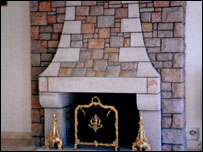 Fireplace built by Mr Benest. He said: “In different parts of the world where I have worked, often granite is quite uniform. But to have such a variety of colour and crystal composition in an area of nine by five in three different corners is just remarkable.” Time-honoured skillsThe last word goes to Mr Benest, who is just one of countless islanders that have dedicated their lives to working with granite. And, through the time-honoured skills of this most physically demanding of trades, forged a livelihood from the granite formed over 400 million years ago. “I enjoyed it. I even went as far as Marbella and built a granite fireplace and every one of the stones came from St John. It must be the only piece of Jersey in Marbella providing it is still there,” he chuckled. last updated: 07/07/2009 at 09:07 Have Your SaySambotronic SEE ALSOYou are in: Jersey > Jersey Wonders > Stone-age trade  |
| | About the BBC | Help | Terms of Use | Privacy & Cookies Policy |