| 13 November 2014 |

| |
| BBC Homepage | | |
| |||
| Contact Us | | |
Jersey WondersYou are in: Jersey > Jersey Wonders > Jersey's volcanic beginnings 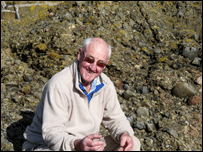 Jersey's volcanic beginningsBy James McLachlan BBC Jersey spoke to a geologist about the formation of the island, and how subsequent generations exploited the natural resources left behind. Jersey is the sort of place that appeals to geologists. Millions of years ago it was in an area near a volcano. The lava which spewed forth formed the dark, mauve coloured rocks peculiar to Jersey. These rock formations around the coastline tell the story of how the island was formed in ancient times. Jersey geologist and author Dr Ralph Nicols believes the rocky outcrop at La Crete between Anne Port and Archirondel is Jersey's version of the Giant's Causeway. 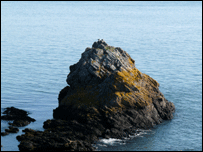 Jersey's answer to the Giant's Causeway La CreteThe unique rocky outcrop at La Crete is one of the most striking exposures of rocks in Jersey, according to Dr Nicols. Dr Nicols said: “The first thing you notice is the structure. It is a series of columns separated by cracks that are tilted towards the Anne Port Bay area. “At first sight, there is not much to them. But it is quite different to anywhere else on the island. Anyone venturing down at low tide will be able to see a polygonal outline at the ends of the columns, which are cut by so-called ‘joints’. Dr Nicols explained: “There are a series of white millimetre thick bands that curve through the rock. These are cut by the joints making the columns.” “Those white curving bands illustrate the flow of the rock when it was lava.” From this seemingly innocuous detail, geologists can say for sure that Jersey was volcanic at one time. By looking at the different ages of the rocks, they can determine the basic foundations of the island. 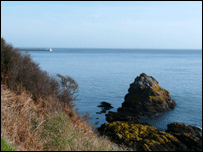 The view from La Crete to St Catherine Dr Nicols is fascinated by how islanders tapped into what is Jersey’s oldest natural resource. He said: “If you examine the stone’s texture and patterns you will notice how, in various parts of the island, the local stone has been used to build walls, houses, churches, jetties, forts and castles. It is incredible how islanders have used the local resources.” Rozel conglomerate - St Catherine’s Tower and slipwayIf you have visited this area, you will have noticed large rock formations that look like jagged concrete. This is known as Rozel conglomerate – a wonderfully local moniker. It is a strange mix of all the other types of rocks in Jersey meshed together. Dr Nicols explains: “It is made up of rounded pebbles set in a matrix of much finer grain sand or silt. In terms of composition, we have got rocks which occur elsewhere on Jersey; the laminated shale from the western and central part of the island; the ryalite from La Crete, and bog standard granite pebbles. In fact, all the other rock units are present in the Rozel conglomerate.” 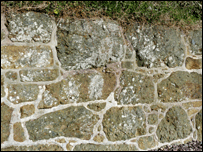 Sea wall made from Rozel conglomerate Proof of the building quality of this hybrid can be seen in the sea wall at St Catherine, which is constructed from large blocks of Rozel conglomerate. It has also been used elsewhere in the island, particularly in houses in the west. Aside from the impressive building quality, Dr Nicols is also amazed by the rock's aesthetics. Dr Nicols: “It may not hit you in the eye as it would when you first walk down here, but the difference in rock type and shape leads you to wonder how it was formed. “After volcanic eruptions, the formation of volcanic rocks and lava flows - how on earth have you ended up with something that looks like concrete?” last updated: 21/04/2009 at 14:17 Have Your SayB rian Rive SEE ALSOYou are in: Jersey > Jersey Wonders > Jersey's volcanic beginnings  |
| | About the BBC | Help | Terms of Use | Privacy & Cookies Policy |