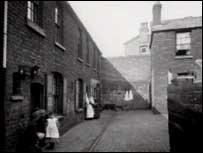
BACK TO BACK TERRACESBirmingham's back to backs were built to house the rapidly increasing working population that swelled Britain's expanding industrial towns. The houses in Birmingham are the last surviving example of 'court' style back to back housing in England. The rows of houses were literally built 'back to back' one room deep. The typical back to back house has three rooms, one above the other. The housing became renowned for squalor, disease and poverty due to its cramped design and poor sanitation. Take a tour and turn back timeSo what was it like to live in a back to back? We approach the houses from a main street although most are reached from a tight entry leading into a squalid yard. 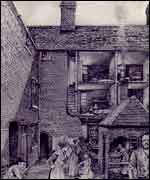 | | The squalid and smelly courtyard |
On entering the courtyard, we can see women washing clothes, families using the communal lavatories, and rubbish being stored in miskins. Once inside the house, we enter a pokey downstairs scullery with a sink and a couple of shelves. This acts as a kitchen, dining room and living room, and sometimes a workshop. Upstairs there's two bedrooms shared by six people. Bugs, vermin and silverfish infest the room. We hold our noses as the pungent yard smells waft through the windows. The stench is overwhelming. Inside a 1830's back to backMy name’s Margaret Mead and I'd like to take you on a tour of my house in 1830. I live on Birmingham's Inge Street with my husband and five children. 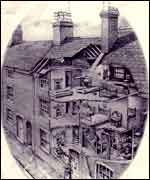 | | This is what our house looks like inside .. |
Our house is a three storey terrace with a common yard, a privy and wash house which we share with fifteen other families. We pay 3d a week in rent. Some of our neighbours are so poor that they do ‘moonlight flits’. I sometimes work from the downstairs scullery as a pearl button driller. My brother glues matchboxes. My husband is a buttonmaker and works long, hard hours. We also have a lodger who is an apprentice bellhanger. Inside a 1920's back to backBette Green was brought up in the back to backs of Hurst Street between 1919-1928. Bette recalls the harsh living conditions,
"There were no beds, we were just lying on the floor. You had bugs, you had rats. It was so awful". Brian Meakin, the last resident, has happier memories of the community spirit in these streets. "Some people say they were slums but e never thought they were slums. It might have been a bit cramped but we had some very happy times here." From slums to showpiece museumNow the back to backs are to be restored by Birmingham Conservation Trust and the National Trust at a cost of £3 million. Visitors will be able to see the houses at different stages in their history - 1802, late 19th century, pre-war 1930's and 1960's. This unique snapshot of life will be open to the public in 2004. We can't wait to see it! | 



 Inside Out - West Midlands: Monday 9th October, 2002