THE LEGACY OF SLAVERY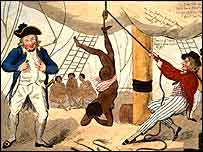 | | Should Bristol build a prominent memorial to the victims of slavery? | |
Look around you in Bristol and you'll see all sorts of reminders of the slave trade that made the city prosperous during the 18th Century. There are concert halls, street names and statues to commemorate the men who exploited slavery. But there is precious little to remember the thousands of victims of the slave trade. The demands for some sort of suitable memorial to the slaves are growing. But what would it look like? Inside Out has decided to kick off the long overdue public debate to recognise the awful plight of the thousands who were forcibily taken to the Americas against their will. Gateway to the west With its strategic position on the River Severn, Bristol has always been a city of merchants and traders. 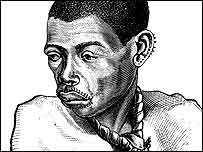 | | The slaves were taken to the Americas in dreadful conditions |
It was almost inevitable that the transatlantic slave trade used the port as a major route out. This abhorent trade lasted for a relatively short time, but its influence on the city's wealth was immense. Between 1200 and 1600, many Bristolians made their fortunes through the cloth and wines trades. They soon controlled all merchant trading going out from the port which in itself became the second biggest city in the country.
In 1698, the monopoly of slave trading, by the Royal African Company, came to an end. It was the port at Bristol that then took a lead in the trade. Tree of hands
The BBC invites three schools to work with local artists to produce inspirational ideas for a slaves' memorial. The pupils gather at the Industrial Museum on the city's historic dockside, and the first group, from inner city St Barnabas Primary School, works with illustrator Tony Forbes. 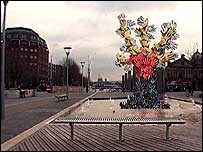 | | The symbolic multicultural tree of slaves' hands |
Their thoughts for the memorial are manifested in a "multicultural tree" celebrating Bristol's diverse communities living peacefully together. The origin of the merchants' wealth was through the labour of slaves. So, in turn, it's the slaves' hands, helping to build the city of today, that are depicted on their tree. The children of Fairfield School are also thinking big. Their vision is to create a giant representation of the bow of a slave ship. Artist Gloria Ojulari Sule imagines it being made of stained glass, but the group make a smaller prototype using cardboard and tissue paper. Gloria says, "I'm getting excited about the idea of designing a monument. There should be something. "It's very much the norm to have art, sculptures, memorials to all sorts of great explorers like Colston and Cabot. We need something now to recognise the part Bristol played in the slave trade." Silent statue Meanwhile the pupils of St Thomas More School, working with artist Valda Jackson, are off on an expedition. 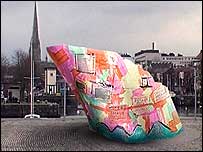 | | The bow of the slave trader's ship is emotionally charged |
They've decided to check out the statue of Edward Colston in the city centre. Colston took an active role in the planning and financing of slaving ventures to Africa. He was also a popular benefactor to the city of Bristol, providing money for a number of charities throughout his life. The statue is no stranger to controversy. It was once daubed with the words "slave trader". There were even suggestions in the local press that it should be torn down. Historian Madge Dresser from the University of the West of England tells the group, "The plaques on the statue demonstrate Colston's expertise as a trader and his charitable giving. "But it's what the statue doesn't say that's so interesting. "It doesn't say that a significant portion of his wealth was based on the labour of enslaved people." 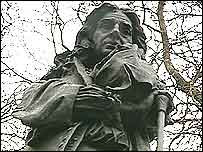 | | Edward Colston's wealth was largely based on the slave trade |
A triangular trade. The rich Bristol merchants would take their goods to West Africa to trade for slaves. The slaves were then transported across the Atlantic to the Americas in appalling conditions. Many did not even survive the journey. When they arrived, they were put to work on the plantations. The traders would then return to Bristol with sugar, tobacco, cocoa, coffee and cotton which were sold for enormous profits. Man's inhumanity to man Back at the museum, a group from Fairfield School are visiting the slavery exhibition. They look at some of the artifacts used to punish the slaves if they stepped out of line. Richard Hart, an historian from Jamaica, tells them, "It's very important for Bristol to have a memorial to the victims of the slave trade. "It was their labour that enriched Mr Colston and enabled him to be so generous to the city of Bristol." As the afternoon continues it's a race against time to apply the finishing touches to the designs. The completed work is greeted with a huge round of applause. | The slaves' plight | 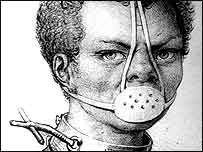 | | A significant portion of his (Edward Colston) wealth was based on the labour of enslaved people | | Madge Dresser, University of the West of England |
"The slave trade is something that happened where we live," says one of the pupils, Layla. "I think it should have more publicity." Her friend James agrees. "Why shouldn't there be a memorial showing what's happened? "It's not something we should forget." So what do you think? Inside Out is teaming up with the Bristol Evening Post and BBC Radio Bristol for a public debate. What do you think of the designs? Should the city build a slave memorial to ease its guilt - or perhaps you think our troubled history should be laid to rest? Send us your comments on the form below... your comments will be published on this website, and possibly in the pages of the Evening Post. Illustrations are published from: "The Atlantic Slave Trade and Slave Life in the Americas: A Visual Record", sponsored by the Virginia Foundation for the Humanities and the University of Virginia Library. | Cast your vote to see the strength of opinion: |
Should Bristol build a prominent memorial to the victims of slavery? This vote is informal and does not represent public opinion | 



 Inside Out - West: Monday January 31, 2005