PORTON DOWN - THE UNWITTING VICTIMS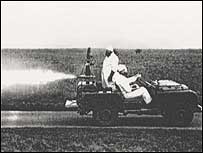 | | Chemical spraying with all its air-born toxicity |
Scientists from Porton Down carried out a top-secret experiment 40 years ago. Alarmingly, it was done on a journey through Somerset and into the heart of Bristol. Until recently details of their experiment remained secret, but Inside Out has discovered the documents which explain what took place. Porton Down was set up in 1916 at the height of the First World War. It was a top secret chemical weapons centre sited on a 7,000 acre site near Sailsbury. During World War II, Porton Down began researching biological weapons, but during the Cold War, chemical weapons became the top priority. It wasn’t until the 1960s that the government admitted the centre’s existence. Cold comfortIn return for payment and a precious pass for three days leave, soldiers from all over the country travelled to Porton Down to be involved in testing. Many had no idea what was involved. Some soldiers were even told that they were taking part in research designed to find a cure for the common cold. Their testing did not end there as Inside Out can reveal. Porton Down’s other batch of unwitting guinea pigs was the general public. On February 1, 1961 a Land Rover set off at 10.45 am from the village of Ilchester. It was driven by scientists from Porton Down. The Land Rover travelled through Wedmore and on to the outskirts of Bristol. As it went, Zinc Cadmium Sulphide was sprayed into the air in an attempt to simulate germ warfare. The cloud was being traced at sampling stations through Somerset and Wiltshire back to Porton. It was the height of the Cold War and the British government feared that the Soviet Union was planning a chemical and biological attack. The government wanted to analyse how a cloud of germs might disperse. The scientists were instructed to handle the chemical very carefully. They were ordered to wear full protective clothing and gas masks. Those handling the material were to be given annual medical checks. Despite the extreme safety precautions the scientists took, they were spraying the chemical cloud onto passers-by. When they arrived in Bristol they would have been travelling through groups of lunchtime shoppers. Toxic blind faithGuardian journalist Rob Evans, has written extensively on the trials conducted by Porton Down: "This was the one trial where people were exposed the most, the one where people got their biggest dose, and the problem with Zinc Cadmium Sulphide is we don't know how toxic it is. The data on how toxic it is, is sparse."
The authorities at Porton Down declined to give an interview, but released this statement.
"There was no danger to public health arising from the release of Zinc Cadmium Sulphide and that in the areas where these trials took place. There was no evidence of increased incidents of diseases associated with cadmium toxicity."
Inside Out brought together a group of Porton volunteers who were unwittingly exposed to the deadly nerve agent Sarin, which can kill in seconds. They were startled to hear how people in the West Country had been used as guinea pigs by the Porton scientists. Rob Evans says; "We’ve known for quite a while that people were tested inside Porton Down. What we’re now finding out is that people outside Porton, people in the West Country, people in Bristol, that they were also part of Porton’s experiments,"
In 1953 airman Ronald Madison died fter being subjected to nerve gas. InvestigationThere are complaints from the servicemen that the tests they went through have caused disabilities from breathing difficulties to kidney complaints. In 2001 the government launched an independent medical investigation into the health of 20,000 volunteers who took part in weapons trials at Porton Down. Meanwhile the Porton Volunteers are waiting to see the results of a major police investigation into their cases. Porton Down fact file Porton Down was set up in 1916. It was a centre designed to test chemical and biological weapons. Nerve gases such as Sarin and CS gas were tested on volunteer servicemen. Servicemen were offered around £2 and three days leave as an incentive to take part in tests. Very few servicemen knew what they were volunteering for and some were even told it was research into the cure for the common cold. In 1953 it is alleged that serviceman Ronald Maddison died after taking part in a Sarin gas experiment. In 1962, one of Porton Down's own scientists, Geoffrey Bacon died of the plague. Since the end of WWII, 20,000 people have taken part in experiments at Porton Down. In 2001 the government launched an independent medical investigation into the health of 20,000 volunteers who took part in weapons trials at Porton Down. The two year investigation will examine death rates of all the volunteers dating back as far as 1939. Ex-servicemen involved in the tests have complained of breathing difficulties and kidney complaints. The Porton veterans in Wiltshire are hoping to set up a local support group. They should be contacted through the national group. | 



 Inside Out - West: Monday 28th October, 2002