The Royal Adelaide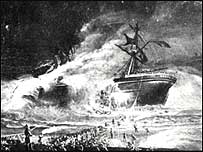 | | Rescue attempts - the Royal Adelaide |
Inside Out visits Chesil Beach in Dorset to tell the dramatic story of a shipwreck. Thomas Hardy called the area Dead Man's Bay. It's a fitting name because there are some 200 wrecks in the bay.
One of them is the Royal Adelaide. Hers is a story of epic proportions - a tale of heroism, fear and wreck fever. What makes this maritime disaster a bit different is that almost as many local people died on shore as at sea. And they died because hundreds of them got at the ship's cargo of alcohol as they watched the rescue attempts unfold from what should have been the safety of this beach.
Titanic escape On the night of November 25, 1872 the Royal Adelaide was in trouble just off the Dorset coast. The vessel, carrying 67 passengers and crew bound for Australia, was trapped in a storm and heading for disaster on Chesil Beach.
But in the face of certain tragedy an amazing and heroic rescue by Portland locals successfully winched 60 of those on board to safety. Ultimately just seven drowned, while four drunken revellers also perished on the night. | ROYAL ADELAIDE |
* 14 November 1782 - The Royal Adelaide, 1400 tons, carrying 32 crew, 35 emigrant passengers and 3,000 tons of cargo (mainly alcohol) departs London for Australia. The ship leaves nearly 10 days later than scheduled.
* 24 November - the five man crew of the vessel The Jane Catherine are drowned in storms off Chesil Beach. * 25th November - after increasingly poor conditions, the Adelaide's Captain Hunter decides to seek shelter at Portland Harbour * By 5pm it becomes evident the ship cannot reach safety and it drifts/rolls broadside towards Chesil Beach. *Hundreds of locals are alerted to the scene and gather to help/ watch events unfold. * Blue lights and blazing tar barrels are used to illuminate the night sky. * Many passengers were ultimately rescued but seven drowned. * On 26 November there is a third wreck in three days, this time the vessel Cassibelanus - all 14 on board are rescued. |
The rescue attempt was dramatic and dangerous. The first attempt came when the lifesaving crew fired a rocket line across huge waves to vessel. Some locals also rushed in to the sea to throw lines on board. But when the rocket fired, no one on board knew how to rig it up properly. Then the ship's first mate and one other person drowned trying to get a line ashore from the ship. The next rescue attempt was using the breeches buoy. Catherine Irons, the passenger stewardess, was the first to try this method but she took hold of the ship's main brace instead of the rope to the apparatus. The cradle was pulled from beneath her and she fell out. After this no passenger was keen to use the breeches buoy so the ship's second mate, Woolly, ordered a negro named Samuel Gibbs to use it which he did successfully Despite this some of the passengers on board were still too scared to use the breeches buoy. Four women and three men made it successfully, but after failing in his attempt to get the passengers off, the captain led by example, grabbed a child and was winched to safety.
Captain Hunter begged to be allowed to go back to ship but was not allowed. After this, the rescue moved swiftly and several passengers were brought to safety, many of whom were children. Final bid for safety The final two to make their bid for safety were Johann Magdelinsky and Rhoda Bunyan who were cheered as they made their way to shore. 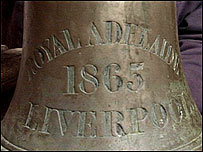 | | The Royal Adelaide's bell was later recovered |
Tragically they drowned when the rope snapped. Rhoda was just six-years-old. Her story is particularly poignant because Rhoda's family was emigrating to Australia - and her mother, father and babe in arms got safely ashore. Rhoda was left alone on the ship and none of the other passengers wanted to take her. Today Johann Magdelinsky, the hero who tried to save little Rhoda Bunyan, lies in St Georges' churchyard. The last remaining passenger on the ship was 71-year-old Louise Fowler who refused to use the breeches buoy, despite the other 10 members of her family making it to shore. She returned to her cabin and went down with the ship. Tragic aftermath | THE DEAD | Passengers and crew:
* Edward Power, 1st mate.
* Mrs Catherine Irons, stewardess, 33.
* Edward Ruddock, sailor, 30.
* John Edwards, sailor, 30.
* Mrs Louise Fowler, passenger, 71. Buried at Stranger's Cemetery overlooking the site of the wreck.
* Johan Magdelinsky, passenger, 49.
* Rhoda Bunyan, 6. On shore:
*George Neale, grocer's apprentice, 15.
* Samuel Biles, butcher's labourer, about 40.
* Thomas Strange, carpenter, 45.
* George Gilbert, hat hawker, 45. |
All the survivors were nursed by locals, and most were taken to the Victoria Inn (now the Ferry Bridge Inn) to recuperate. Within an hour of the ship's back being broken, the beach filled with all of the goods on board. A treasure hunt started as locals tried to pillage goods washed up from the Adelaide. Locals ran off with alcohol, sewing machines, and even pigs, some risking their own lives to siege cargo floating near the shore. By the next morning some drunken revellers were near death or had died from intoxication, exposure or hyperthermia, including George Neale, a 15-year-old grocer's apprentice. Amongst the stories of stupefied pillagers is that of John Stone who was rescued just in time by a friend after lying across the railway line. Others died of excess alcohol. Safety lapses
Captain William Hunter was ultimately held responsible for the wreck happening.
He admitted that he did not have all faculties when the crisis happened, he did not know how to use the breeches buoys, and had never been trained in such matters.
At the inquest held a month later his captaincy licence was revoked for 12 months. The broken remains of the Royal Adelaide still lie close to Chesil Beach.
The shipwreck remains one of the most tragic off the south of England coast.
Links relating to this story:The BBC is not responsible for the content of external websites | 



 Inside Out - South West: Monday February 13, 2006