The mystery of Conan Doyle 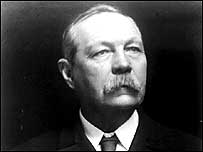 | | The mystery of Arthur Conan Doyle. Photo: PA Images |
Dartmoor will forever be associated with Conan Doyle's best known story - The Hound of the Baskervilles. But what if new evidence came to light that Conan Doyle was not the true author of the story - that he was a plagiarist, an adulterer and a murderer? Could someone else really have written The Hound of The Baskervilles? Inside Out investigates a mystery as complex and curious as a Sherlock Holmes murder case. Hound of the Baskervilles The Hound of the Baskervilles is one of Britain's best loved detective stories featuring the nation's favourite master sleuth, Sherlock Holmes. But could it be possible that the story was plagiarised from another writer?
Devon author Rodger Garrick-Steele believes that Conan Doyle lifted the story from a fellow writer, Bertram Fletcher Robinson: "The story had already been written - it was Bertie's manuscript called An Adventure on Dartmoor, and this is what was converted into The Hound of The Baskervilles."
He claims to have found circumstantial evidence that Conan Doyle may have murdered his former friend when he became worried that the deception might be exposed. Garrick-Steele also believes that Arthur Conan Doyle may have been having an adulterous affair with Robinson's wife. So is this a tale of more than just plagiarism? The plot thickens... Our story requires further investigation so Inside Out decided to collect some clues to help solve the loose ends in this mystery. Let's start with what we do know about Conan Doyle.  | | The Hound of the Baskervilles - cult fiction and film |
Arthur Conan Doyle originally trained to be a doctor and for a short time shared a practice in Plymouth's Durnford Street. Twenty years later he returned to the South West of England with his friend Bertram Fletcher Robinson who had captivated Doyle with the legends of hounds on Dartmoor. The two agreed to write a book. Fox Tor Mires was one of many places they visited. It would be the inspiration for Grimpen Mire in The Hound of the Baskervilles. It was a place full of mystery and Conan Doyle wrote of it - "A false step yonder means death to man or beast". The mysterious case of the two writers After the visit, the two men returned to the old Duchy Hotel in Princetown, and this according to Garrick-Steele is where things took a strange twist. Conan Doyle wrote to his mother telling her that the story was nearly half written. But Garrick-Steele asks how could this be if Doyle had only spent one day on Dartmoor?
Author and leading expert on The Hound of The Baskervilles, Philip Weller, believes there is a logical explanation: "The first third of the story doesn't take place on Dartmoor, so it's perfectly reasonable he'd written it before arriving on Dartmoor."
Conan Doyle went on to enjoy huge success with the finished book. The Hound of the Baskervilles became an instant classic inspiring countless film and television adaptations. But Doyle did credit Robinson which may rule out the murder theory. Garrick-Steele isn't convinced:
"Well, he had to
. Fletcher Robinson had already written the story." Rodger Garrick-Steele believes that it was Robinson alone who wrote The Hound of the Baskervilles.
A study in adultery? Rodger Garrick-Steele also believes that Conan Doyle had an affair with Robinson's wife. 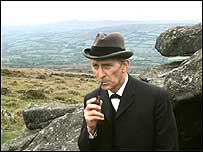 | | A mystery to baffle Sherlock Holmes |
He claims that Robinson's wife Gladys committed adultery with Conan Doyle in a bid to get pregnant. "We believe she had an affair... we cannot prove it," he says. But Philip Weller doesn't agree: "Arthur Conan Doyle was a man of integrity
I don't think he was capable of being an adulterer." Murder most foul? But that isn't the end of the speculation about Conan Doyle's private life. Garrick-Steele claims Conan Doyle murdered Robinson, fearing he'd be exposed as a plagiarist and an adulterer. It's a mystery that even the great Sherlock Holmes might struggle to unravel. According to official records Bertram Fletcher Robinson died in 1907 at the age 36 from Typhoid. But Garrick-Steele thinks Conan Doyle poisoned Robinson with laudanum, using his medical knowledge as a qualified doctor. The case of the poisoner? An application has been made to have Robinson's body exhumed. The Diocese of Exeter are expected to announce a decision within weeks. Garrick-Steele believes it was unusual for a Typhoid victim to be buried rather than cremated 100 years ago, and suspects foul play. Not necessarily according to Dr Anne Hardy from University College London: "In the case of Typhoid it was very important that body fluids didn't escape from the coffin so it would probably be lined. The public health authorities would trust a middle class family to do things properly so the chances of an enforced cremation seem to me very unlikely."
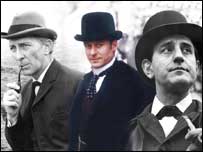 | | Conan Doyle's super sleuth on TV and in the movies |
Garrick-Steele believes that Conan Doyle had Robinson poisoned with Laudanum - a common pain killer at the time. But would Laudanum really mimic the symptoms of Typhoid? "Stupor and coma are both features of the condition, but in Typhoid you would also see the patient suffering fever and a rash of spots across the chest. "There are very distinct features which can distinguish the two conditions," says Anne Hardy. So how would Garrick-teele feel if an exhumation confirmed that Robinson died of Typhoid? "I'm not so sure I can accept that. If there is Typhoid how do we know it's Bertie's body in there?" he says. Unsolved mystery? Arthur Conan Doyle has been accused of plagiarism, adultery and murder so what does Philip Weller make of it all? "There is only one person making these claims
there is little evidence to support them
there is a lot of hard evidence to refute them."
So will we ever find out how Robinson really died? It's now up to the Diocese of Exeter to decide whether the exhumation should go ahead. Until then, this is one Conan Doyle mystery that will remain far from having an elementary solution.
Links relating to this story:The BBC is not responsible for the content of external websites | 



 Inside Out - South West: Monday February 20, 2006