THOMAS BODLEY - THE BOOK MAN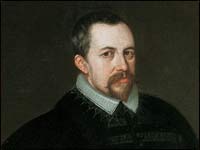 | The saviour of Oxford's greatest library |
Exeter-born Thomas Bodley helped create one of the world's great libraries. But the birth of the Bodleian had as much to do with pilchards as printing. Thomas Bodley was born in 1545 to a staunch Protestant family in a house on the corner of High Street and Gandy Street in Exeter. His father, John, was an Exeter merchant and his mother, Joan was the daughter of another Exeter merchant from Ottery St. Mary. The Bodleys were forced to flee to Geneva to avoid persecution at the hands of Queen Mary. When they returned to London 7 years later, Thomas was installed as a scholar at Oxford University. In 1586, after a two year stint as MP for Portsmouth, Thomas was returned as MP for St. Germans, Cornwall. Soon after he married wealthy Ann Ball, the widow of a local merchant from Totnes. Pilchard pickingsAnn's wealth came from her husband's pilchard business and it was to secure Thomas's future and bankroll his ambition - to build a bastion of Protestantism out of books. First Bodley became a roving ambassador for the new queen - Elizabeth. He was a skilled diplomat going on important secret missions to Denmark to help advance the Protestant cause he believed in passionately. But after eventually falling foul of the queen, in 1597 Bodley came to Oxford. He wanted to crown a life of public service by helping restore the university library, which by the late 16th century was in a desperate state. He offered to help - by now Bodley was rich - and the university realised with his connections they had found a saviour. The value of a good readThe library had lain empty since about 1550, when almost all the books had been removed by the reforming Commissioners.  | | Our Inside Out man gets lost in the library stacks |
Books were very valuable - one book would cost the equivalent of a year's wages - but Bodley was gifted at getting money and donations from the good and the great of the day. He developed the techniques many charities still use today - making sure that all the benefactors got a good plug. Donations flooded in. Bodley was clear about what sort of books he wanted for his library - they were to be of a high and serious nature. He wrote to his librarian that he wanted no plays, almanacs or 'riffe raffe' books on the shelves. Bodley wanted religious works in his library to help prove the Protestants right and the Catholics wrong. No books were lent out - because they had a habit of never returning. A good deal
 | | A signpost to the Bodleian Library |
Bodley realised that if the library was to keep growing he couldn't just rely on on donations - and so he secured an agreement that was to mean the library would keep growing for ever. He struck a deal with the stationers' company entitling the Bodleian to a copy of every newly printed book.
This greatly accelerated the rate at which the library grew - nowadays some 1500 books a week come into the library. Bodley lived just long enough to see the start of a massive extension to his library. He died in 1613 and was buried in Merton Chapel, Oxford. His legacy is the hundreds of thousands of books - with millions more dotted around Oxford - now available to scholars from all over the world. | 



