Aircraft Contrails  | | Do aircraft contrails contribute to climate change? |
Could aircraft flying the busy South East air corridor be wrecking the weather and leaving a grim legacy for future generations? On board the Discovery space mission in 2006, the British astronaut, Piers Sellers from Crowborough, was able to take a walk in space and look back towards home. What he saw was the South East region blanketed not in clouds, but condensation trails from aircraft. What are contrails and how do they form?Contrails are vapour trails, artificial cirrus clouds made by the exhaust of aircraft engines or wingtip vortices that precipitate a stream of tiny ice crystals in moist, frigid upper air. They are not pollutants. Contrail creationContrails are created in one of two ways: Firstly, the airplane's exhaust increases the amount of moisture in the air, which can push the water content of the air past saturation point. This causes condensation to occur, and the contrail to form. Aviation fuel consists primarily of hydrocarbons. When the fuel is burned, the carbon combines with oxygen to form carbon dioxide; the hydrogen also combines with oxygen to form water, which emerges as steam in the exhaust. For every gallon of fuel burned, one gallon of water is produced. 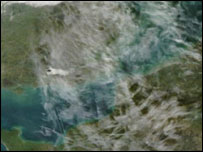 | | Contrails are visible from satellites orbiting the South East |
At high altitudes the water vapour faces low temperatures, which cools the vapour until it condenses into tiny water droplets. Myriads of water droplets and/or ice crystals form the contrails. At high altitudes, super cooled water vapour requires a trigger to encourage desublimation. The exhaust particles in the aircraft's exhaust act as this trigger, causing the trapped vapour to rapidly turn to ice crystals. Contrails only occur when the outside air temperature around the aircraft is at or below minus 57 degrees C. Drop in pressure
Airplane wings cause a drop in air pressure in the vicinity of the wing. The reduction in air pressure brings with it a drop in temperature, which can cause water to condense and form a contrail at high altitudes. At lower altitudes, this phenomenon is known as Ectoplasm. Ectoplasm is more commonly seen during high-energy manoeuvres. E.g. fighter jets, jet liners during takeoff and landing, or around turbo-fan intakes on takeoff. Exhaust contrails stableExhaust contrails tend to be more stable and long lasting than wing-tip contrails, which are often disrupted by the aircraft's wake and are short-lived. Cambridge University astronomer, Dr. Gerry Gilmore, has predicted that by 2050, the telescope will be a redundant tool because the skies will be blanketed with clouds formed by contrails. His claim has been disputed by some, but it seems inevitable that the skies will get even busier
and that could mean a rather a grey and cloudy future. Contrails and climateContrails, by affecting cloud formation, can act as a warming factor. Various studies have found that contrails trap outgoing heat emitted by the Earth and atmosphere at a greater rate than they reflect incoming solar radiation. Therefore, the overall effect of contrails is a warming. Night flightsSome studies have shown that night flights are most responsible for the warming effect. Accounting for only 25% of daily air traffic, they contribute 60 to 80% of contrail radiative forcing. Similarly, winter flights account for only 22% of annual air traffic, but contribute 50%of the warming. 9/11 effectThe first clue came from an unlikely and tragic event. In the days after 9/11, aircraft across the USA were grounded for three whole days. Surprisingly, there appeared to be a change in the weather. Scientists found the difference between day and night temperatures was one degree greater than usual. It appeared that the lack of contrails had led to clear blue skies and an increase in daytime temperatures. It seemed to confirm that contrails are contributing to a phenomenon known as "global dimming", blocking out radiation from the sun and cooling the planet. Global warmingBut that is not the end of the story. The same clouds that block out the sun are also trapping in the earth's heat and, as a result, contributing to global warming. So which is it? Are contrails cooling us or heating us? In Herstmonceax, East Sussex, researchers from Reading University have begun to measure which effect is the greater. Being on one of Europe's busiest air corridors made it the ideal place to test the effect of contrails.
Links relating to this story:The BBC is not responsible for the content of external websites | 



 Inside Out - South East: Monday September 18, 2006