Arson - paying the price 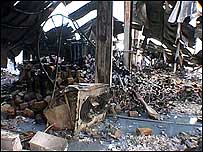 | | Wrecked lives - a suspected arson attack |
Arson is the largest single cause of major fires in the UK - it leads to death and significant financial damage. The bold statistics are frightening - every week there are 2,000 arson fires, two deaths, 60 injuries and a bill of £42 million. But behind the headlines lies another story - how a single moment of madness changes lives - and rarely for the better.
Blazing fire The North West recently saw one of its biggest fires ever with flames 100 feet high, temperatures hot enough to melt steel beams, and roads closed as black smoke enveloped the area. This blaze at a DIY wholesale warehouse at Walkden in Manchester is being treated by police as arson. | "It was just reminiscent of what you see in the Blitz... just total decimation." | | Risa Klyne, owner |
The fierce heat caused the building to collapse, and an enterprise covering nine acres was in ruins in as many hours.
For the owners - Risa and Sammy Klyne - it was a personal and commercial disaster. They set up their multi-million pound business 20 years ago, building on their success with market stalls.
A few weeks ago they'd just had one of their best weeks ever. Now all their hard work has been annihilated. | ARSON FACT FILE |
Each week in the UK:
* Twenty schools and colleges are damaged or destroyed by arson.
* Over 260 homes are damaged or destroyed by arson.
* Three hundred and sixty businesses and public buildings are damaged or destroyed by arson.
In the last decade there have been around 2.4 million deliberate fires in the UK, resulting in 1,250 deaths and 32,000 injuries.
Home Office research puts the cost of arson to the economy at £2.2 billion per year. Many businesses never entirely recover losing orders, contracts, key employees, or may going out of business. Forty per cent of those prosecuted or cautioned for arson offences in 2000 were aged 10 to 17. Source: Arson Prevention Bureau |
But it's not just the Klynes who are suffering - they have a workforce of 80 people with families to support. Now their business lies in a crumpled heap, Sammy and Risa have hard decisions to face. The cause of the fire is still being investigated, but the Klynes have realised they've no option but to lay-off 50 of their 80 staff. The consequences, though, don't stop there, as Sammy Klyne explains:
"The ripple effect - it just keeps getting bigger and bigger... People would buy off us and their stores were all dependent on my product. What are they going to do?
"One supplier has had to go down to a two and half day week because he can't send the product in... there's nowhere for the product to go." And Risa says that the human cost can be equally devastating: "It's not just about a building burning down - it's about the effect on human beings - on people who are decent, hard working, good people who come to work everyday. "They put their hours in, they put their effort in, they put their energy into building something, and then it's just destroyed - and it's just left a smouldering mass of wreckage. "It's not just about a wrecking ball coming in on this building, it's about a wrecking ball on people's lives."
In spite of all the heartache and financial losses, the Klynes say that they're going to come back bigger, better and stronger as a business. Fire investigation
In Merseyside there were 16,000 malicious fires last year. Now fire investigators have a specialised and highly sensitive weapon to tackle arsonists - his name is Floyd and he's a dog.
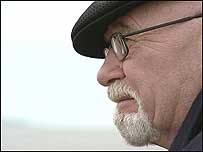
Dean Bolton from Merseyside Fire and Rescue is Floyd's dog handler: "We'll be called out by one of the fire investigation teams and the role is to try and establish whether any accelerants have been used to start the fire. In doing so we can determine whether it was deliberate or not."
Floyd is trained to detect a list of approximately the 12 most commonly used accelerants - from petrol right the way through to barbecue lighter fluid, white spirit, odourless white spirit as well as turps and thinners.
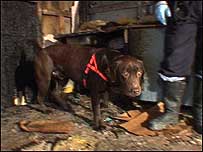 | | Sniffing out the evidence - fire fighter dog Floyd |
The dog and his handler will search over the property and try to determine whether any accelerants have been used. If the dog's not able to detect anything, it cuts down the working time for the fire investigator. The investigator will then go on to look for something else and try to discount other possible causes.
So how successful has Floyd been?
"One hundred per cent - if there's anything there he'll find it," says Dean Bolton. Human impact
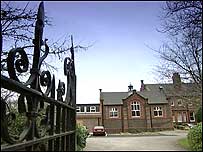
Inside Out visits a children's nursery at Halewood that has been badly damaged by arsonists - Floyd and Dean will be the first investigators to go in. Floyd's work rules out petrol or other accelerants, so it's back to basic fire investigation. For the parents with children at the Halewood nursery, the consequences of the arson are already being felt. "I'm disgusted - absolutely disgusted, they don't realise what they've done," says Claire James. "They've destroyed an area for children... I've had to take a week off work to keep the children at home obviously because the nursery isn't running. "And as an effect, everybody is losing money, I'm sure it's not just me. "The nursery is losing money, they're all losing money, and as parents we can't go to work because we have no childcare." Devastating attack A month ago, Gordon Lord's world came tumbling down when someone set light to his Littleborough pigeon loft and locked the doors. | "I think about it when I'm going to sleep... It's like a bereavement - it's like you've lost one of the family or something." | | Gordon Lord, pigeon loft owner |
Inside were 100 prize-winning racing birds. Nearly all burned to death. "They're everything - I live for them - they were my life," he says.
"It's devastating - you're thinking about it all the time. The day after I must have come down here about five times, and I don't even know what for. As well as the emotional trauma, there was also a financial loss.
The birds were rare and each was worth at least £500 - the fire has cost Gordon £50,000, and there's the prospect of another £10,000 to rebuild the coop. But it's not just the money.
"They should think what it means to people," says Gordon.
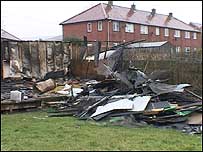 | | Paying the price - the wreckage of the pigeon loft |
"It doesn't matter whether it's a works, or animals or whatever it is. The devastation is the same for everybody. "There was another case in Rochdale where they burnt a pony - they sprayed petrol on its back legs and set fire to it. "Now those people know exactly what they're doing." Gordon refuses to be beaten by the arsonists. He's going to re-stock and carry on. "We're not going to give up because if we do, then whoever's done have won haven't they? That's what their intention is - to hurt and family and stop us racing pigeons," he says.
Consequences of crime In Lancashire, there have been 800 arson incidents in 2006 alone. 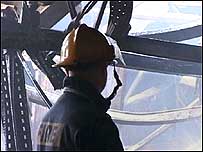 | | Sifting through the wreckage after an arson attack |
Convicted children can be sent on a course to be taught about the danger of fire - and the consequences. We meet a young arsonist who has been through the course, and now has a job. She's repentant about her involvement in the arson attack - we've agreed to conceal her identity: "I was going out with a bad boyfriend at the time. Things happened, and we just got a bit drunk. He'd had a row with someone he knew and we decided to go down and set his car on fire.
"It upsets me sometimes. Even now I've still got friends and some family that don't speak to me, even though I've changed so much. "And it does get me down, and it really does upset me but I know that I've made myself better again and I've pulled myself through it all. I've realised what I've done and I was stupid."
Arsonists can face 14 years in prison but lack of evidence means fewer than one in 10 crimes end in a conviction. Links relating to this story:The BBC is not responsible for the content of external websites | 



 Inside Out - North West: Monday March 6, 2006