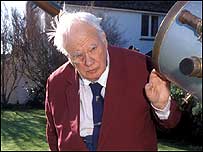
Patrick Moore web chat | 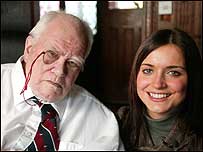 | "I always expect the unexpected..."
Sir Patrick Moore | Patrick Moore with presenter Jacey Normand |
Jodrell BankInside Out celebrates 50 years of listening to outer space with the Lovell Telescope at Jodrell Bank. We also meet Sir Patrick Moore and ask if there's life on Mars. Read the answers to the web chat 'question and answer session' with with Sir Patrick Moore below...
Secrets of the universeIs there life on Mars? And are we really alone in the Universe?
These are questions people have been asking since time and immemorial. But if anyone knows the answer it is the astronomers at Jodrell Bank Observatory in Cheshire. The Lovell Telescope is celebrating its 50th anniversary this year. 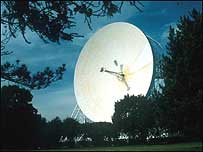 | | Jodrell Bank - an iconic symbol on the Cheshire landscape |
For half a century it has been probing the heavens, listening and searching to discover more about the Universe and its origins. It's also been probing the question we all want to know the answer to - are we alone?
Spanning 5,000 square metres and weighing 3,500 tonnes, the Lovell Telescope is still the third largest in the world. This massive dish receives radio waves from the furthest reaches of Space. These waves strike the surface of this bowl and point them up to the Focus Tower from where the signals are gathered and transmitted for analysis in the observatory.
But the radio waves the Lovell Telescope picks up are so weak that were you to harness the energy from all the signals it has ever received, there still wouldn't be enough power to boil an egg!
What radio waves may lack in power they more than make up for in the information they are capable of transmitting.
The radio signals being deciphered at Jodrell Bank could unlock some of the Universe's greatest secrets - including the possibility of life on other planets. To the stars and beyond
It's a far cry from the original radar equipment that was erected in a field at Jodrell Bank by the telescope's creator Sir Bernard Lovell in 1945. Sir Bernard describes the early days of creating Jodrell Bank: 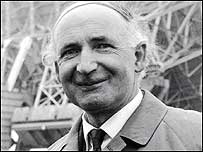 | | Sir Bernard Lovell - creator of the telescope at Jodrell Bank |
"I borrowed an army gun laying radar from a friend and set it up in Manchester in the old physics building on Coupland Street. "There was massive interference. "The electric trams were then running up and down Oxford Street.
"So I eventually got permission to come to this place, Jodrell Bank, where it was sufficiently remote then from Manchester to be free of interference."
In the early days Sir Bernard used the radar in an attempt to search for cosmic rays but he quickly released he needed a larger telescope: "It turned out to be almost beyond the limits of what was technologically possible to build in those days. "And there were no enormous cranes, one had to build a crane to move another crane to command the structure, but eventually in 1957 it was then surrounded by 19 miles of scaffolding tubing. "These were gradually diminished and the telescope became usable. "We first tested it in August 1957 but I was in great difficulty. "I'd overspent for various reasons that are not relevant at the moment and had been investigated by the public accounts committee, so the initial operations of this telescope in 1957 were not particularly happy ones."
Space - the final frontier The telescope's saviour came out of the blue.
The Soviet Union launched Sputnik I - the very first space satellite, and the Lovell Telescope was the only instrument in the world at that time capable of tracking its carrier rocket. 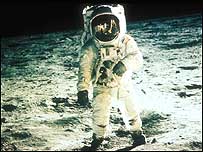 | | Man on the moon - Buzz Aldrin in July 1969. Photo - PA Images. |
Sir Bernard Lovell recalls that historic moment: "Instead of being accused of wasting the country's money, we became front page news."
When the Apollo 11 spacecraft was launched into space in July 1969, the telescope at Jodrell Bank tracked the historic mission every step of the way.
And the Lovell Telescope has been used to track space missions ever since - including the ill-fated Beagle 2 mission to Mars four years ago.
The Sky at Night
The Lovell Telescope isn't alone in celebrating its 50th anniversary. The Sky at Night was first broadcast in 1957 and the show's famous presenter Sir Patrick Moore has taken a very keen interest in Jodrell Bank over the years. We asked Sir Patrick Moore what he thinks makes Jodrell Bank so remarkable:
"It was the first really big radio telescope in the world, and when it was planned radio astronomy as a science didn't really exist, at least not properly... 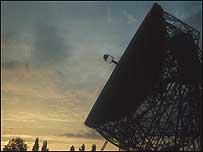 | | Jodrell Bank - led the way for the world's radio telescopes |
"It's not only the optics, it's the engineering too, and that had to be thought out. "When it was first mooted, most were very dubious - could this be done? "Well, Bernard showed that it could, and that set the pattern for all those who followed it. "All the world's big radio telescopes now are descendants from Jodrell Bank - and Bernard Lovell is himself personally responsible. I always regard him as the Isaac Newton of radio astronomy. "Don't forget, radio waves can penetrate clouds of gas and dust - particularly dust, and they can show us things that we couldn't find out otherwise - and certainly radio astronomy is now a fundamental part of research. "It's not fair to say it's taken the place of optical astronomy, it hasn't, the two are complementary. Therefore, Jodrell Bank is of fundamental importance."
Life on other planets?
So is it feasible that one day Jodrell Bank might be the telescope that gets the first message from outer-space?
Patrick Moore believes that we cannot rule out life beyond planet Earth: "It might well be because, after all, I am sure there are other civilisations up there. "Look at it this way, our sun is part of a hundred thousand million stars in our galaxy. We know a thousand million galaxies. "Therefore there must be thousands of millions of Earths and therefore it's absurd to see us as the only ones. "Therefore there must be other civilisations and they could contact us. Whether they will, I don't know, but it could happen. "It might happen tomorrow, it might happen in 100 years, 1,000 years - it might never happen, but I think it will.
"And if there really IS life on Mars the astronomers at Jodrell Bank should be the first to know about it."
Listening to the Universe
Jodrell Bank is now part of a nationwide network of radio telescopes called Merlin which together provide an even more sophisticated way of listening to the Universe. Ian Morison says, "The future is for larger and more sophisticated telescopes, but not looking like the Lovell Telescope. 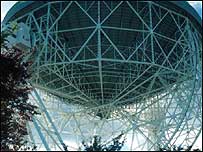 | | Looking to the future - Jodrell Bank continues to play a key role |
"It's the third largest in the world; I don't think any more big telescopes like that will be built. "What you can do now is to build an array of very small dishes, perhaps only 10 metres across and you can combine the data from all these small telescopes to make the effect of one giant telescope."
So would that enable us to probe deeper into Space and determine whether or not we're alone in the Universe?
Ian thinks that it might: "That telescope will be so sensitive that if anyone exists anywhere in our Galaxy, we would have some chance of picking up some signals from them. "So far we've only really looked in our own little backyard of our Galaxy..."
There is still much we have yet to learn about the Universe. But undoubtedly the Lovell Telescope has made a tremendous contribution to our current understanding of Space. Sir Bernard Lovell's dream lives on and is set to play an increasingly important role in tracking our universe and beyond:
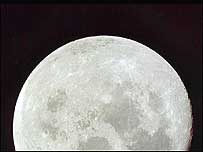 | Evolution of the universe under the telescope.
Photo - PA Images |
"I think we know very little. Every discovery in science nearly always leads to, not to final answers, but to others... "Now I'm old enough to have lived through nearly every cosmology since scientific cosmology existed, and I therefore doubt if the current wisdom is the correct one. "Vast problems are involved there. "With these techniques we've probed back into what must be the very early history of the Universe, 13 or 14 billion years ago, but there are many mysteries which have arisen even in the last 15 or 20 years. "It turns out at the moment for example that the amount for dark energy and dark matter in the universe, of which we have very little idea and no certainty as to what it is, occupies more than 90 per cent of the total mass and energy of the Universe. "And these sort of problems are right in the front line, and I hope I shall live long enough to see some answers to them." | 



 Inside Out - North West: Friday February 23, 2007