Weird weather | 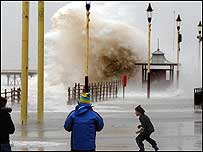 | "These were some of the strongest winds we'd observed for perhaps the last 25-30 years. " Alan Goodman |
Weird weatherWeird weather is an increasingly familiar and worrying trend as climate change kicks in. The North West of England is no exception to the wiles of the weather. Andy Johnson discovers the human cost of climate change as he speaks to people who lost loved ones in the recent storms. Eye of the stormThe wind storm which swept across the North West began life on January 16, 2007 off the coast of New York where warm air began mixing with Arctic winds coming down from Newfoundland. Seven miles above the Earth, the jet stream carried the storm across the Atlantic in just two days - half the time it would normally take. In the space of a few hours the storm would rip through the North West of England, leaving death and devastation.
The first warnings came in the centre of Manchester as parts of a construction site began to crash down on the roadway, injuring a woman in Bridge Street. 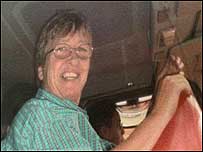 | | Christine Doran died in the storm in Liverpool |
The storm gained in strength resulting in road closures, eventually bringing the city to gridlock.
In the Wirral, the Cheshire Oaks shopping centre was shut at 11.30am as safety officers declared it too dangerous. The wind was gusting to almost Hurricane strength - and it signalled the start of the storm's lethal peak. Alan Goodman, Senior Forecaster from the Met Office, recalls the chain of events: "These were some of the strongest winds we'd observed for perhaps the last 25-30 years. "We were seeing mean wind speeds at some of the principal airports approaching 50 knots - that's getting on for 55-60 miles per hour, with one or two guests exceeding 80 miles an hour at Blackpool airport, down the coast at Crosby. "So these were pretty rare speeds, rare events and certainly obviously capable of course of causing significant damage."
Indiscriminate killerJust before noon on the 18 January, the storm turned into a widespread and indiscriminate killer. In the Garston area of Liverpool a driver died when his car crashed with a fire service vehicle responding to an emergency landing at the city's airport. 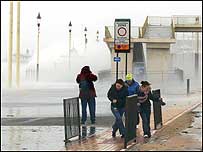 | | Hurricane strength gusts lifted people off their feet |
The EasyJet plane had been diverted from Stansted and was short of fuel.
Christine Doran was returning home with an empty lorry - witnesses told police the wind simply lifted her vehicle over the parapet and into the water.
Tricia Foster had been Christine's partner for 17 years, and the couple were due to marry in a civil ceremony in summer 2007.
She's still coming to terms with the loss: "I can't begin to tell you the pain I feel. God help anybody else from that day, that's all I can say, who lost loved ones, like me, probably went out and never see them again because of the wind."
Multiple deaths Fifity miles south of Skipton the storm was at its height. In Marple it claimed the life of a 60-year-old woman. Joyce Cosadinos had taken shelter behind a five feet high wall, but was crushed to death as a gust toppled it onto her.
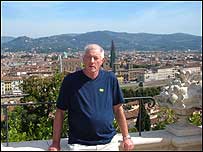 | | Weather victim Derek Barley was hit by a tree |
Just five minutes later victim number number four was hit - on a construction site near Northwich. Electrical engineer Derek Barley was 61, and was trying to restore power to a gas storage plant. He was hit by a tree and died in hospital.
As Derek Barley lay dying, a German lorry driver was killed on the Chester by-pass when his vehicle overturned on top of a car.
And 10 minutes later a grandmother was blown off her feet as she went shopping in the centre of Manchester. Yung Kiu Wong suffered a serious head injury as she crashed onto the pavement in Corporation Street. She died five days later. Blown off your feet
It was the gusts which killed most that day and virtually all of the victims died in urban areas. So how can wind blow you off your feet? Inside Out visited Manchester University's School of Mechanical, Aerospace and Civil Engineering which has one of the biggest wind tunnels in the country. We tried to recreate the recent bad weather conditions using the tunnel. 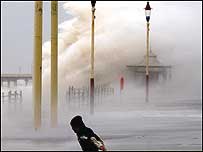 | | A fierce storm can easily blow people off their feet |
The wind pushes anybody back quite a bit and our presenter Andy Johnston has trouble trying to stand upright: "That was quite incredible. It built up obviously very, very slowly... but suddenly I felt this enormous force. "I could feel my legs going, I could feel everything being pushed against me. I couldn't see because my eyes were watering and it was quite frightening to be honest with you."
Alan Goodman from the Met Office says that conditions can be worse in cities and towns: "In the countryside it's relatively flat, there's little obstruction to the passage of the wind so you generally get a more consistent even wind speed...
"But when you go into the towns and cities with lots of tall buildings as there are nowadays, then the effect of the buildings is to effectively channel the wind flow depending on where it's coming from in the first place. "And it can cause some very localised, very sharp gusts of wind."
Crosby recorded one of the highest gusts on the day of the storm - at its the peak the wind speeds reached 73 knots or 85 mph. Buildings crashing down
On that same day local councillor Jack Colbert was walking through the centre of Crosby:
"I just heard this big bang, crash and I looked round the corner... there was half the building - the gable end fell on the taxi and crushed half the taxi from the passenger side to the rear."
The cab driver walked away from this wreckage without a scratch.  | | Yung Kiu Wong - victim of the storm in Manchester |
At the same moment the taxi driver was having his incredible escape, in Bamber Bridge the windstorm was claiming it's seventh victim of the day. A metal canopy at a Sainsbury's petrol station was blown off the roof by a gust. Martin Hunt from Essex was hit in the arm and died in hospital.
Simultaneously, the gusts were striking in the Strangeways area of Manchester where John Cook was making a delivery.
The gust blew him backwards and he hit his head - he also died.
An hour later, with the winds beginning to decrease, the storm claimed its final casualty. In Prenton, 88-year-old Fred Jones had a fatal heart attack as he tried to repair a fence. Devastating impact In the space of just three hours, the wind had claimed nine people.
The traffic jams that developed as motorways and main roads closed didn't clear till well into nightfall, and many homes had lost power supplies. 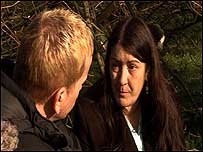 | | Tricia Foster lives with the loss of her partner who died in the storm |
It's easy to dismiss the storm as a one-off freak of weather, but weather experts have a warning for the future. They say that we should get used to these winds because they're here to stay, as Alan Goodman explains: "Instead of these winds being a once in 25 year event, we'll perhaps be looking at say a one in five to 10 year event so certainly we're looking at an increased frequency of wind events in future winters."
The human cost is almost too frightening to contemplate as those who lost loved ones in the January 2007 can testify. Tricia Foster lives with that loss every day: "I can't move on, I can't recover from this. I've had traumas in my life, I've had them all my life, but this has destroyed me, totally destroyed me."
Links relating to this story:The BBC is not responsible for the content of external websites | 



 Inside Out - North West: Friday February 16, 2007