Pakistan ship breaking 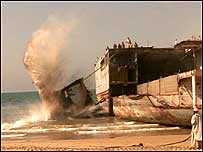 | | Wrecking ball- breaking up ships in Pakistan |
One of the most controversial debates on Teesside in recent years has centred on the fate of the so-called ghost ships. The ships have been slowly rusting away for the last two years as Able UK battles to convince officials they can break them at the highest environmental standards. Inside Out investigates the latest development and travels to Pakistan to discover the shameful truth about how the British Government is guilty of double standards. Ghost ships It's a familiar sight on Teesside - the shape of the ghost ships off the coast of Hartlepool. The dismantling of these American warships would bring hundreds of jobs to Teesside according to Able UK who hope to break the ships up. But critics of the scheme have serious health and safety concerns. Shipbuilding is an integral part of North East heritage - but it has a lethal legacy.
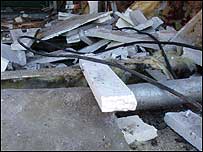
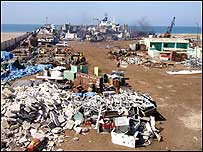 | Ship breaking in a Pakistan yard |
Vessels from this era contained asbestos and they're now reaching the end of their useful lives - so what does the Government do with ships it no longer needs? At present the yard where the ships are based is quiet as a grave. Able UK would normally have about 200-250 people working at this dry dock and it would be full of ships being recycled. But it remains quiet because a decision on the future of the ships is still awaited. Scrapping ships safely? In the meantime it seems the British Government is much less choosey about how we scrap our own ships. Inside Out visited the the Sir Geraint, a former warship renowned for her Falklands campaigns. She's now being torn apart on a beach in Pakistan. The Sir Geraint was beached at Gaddani just a week before we arrived and she's already barely recognisable.
She's being cut into large pieces, dragged on shore and then dismantled further.
It's quick and basic, unregulated and dangerous. We spoke to workers who expressed safety concerns. One said, "I've seen lots of accidents and I've seen lots of people who've lost their lives." Another claimed to have spent six months in hospital when he was injured. "In Gaddani there is no safety but I am alive because of Allah," he says. Sir Geraint is being dismantled by Bismilla Maritime Breakers. We asked its owner whether he has a policy for dealing with hazardous materials like asbestos. "When we find asbestos, we put it in a hole in the ground and cover it up," says Ovais Shaukat. He claims that no asbestos has been found on this ship. But the workers we spoke to said didn't know how to recognise asbestos. Ship breaking in Pakistan So why do people bring ships to be broken in Pakistan?
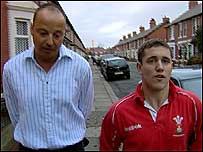
"The UK has an environmental problem and a Greenpeace problem with the demolition of these vessels," Ovais Shaukat. 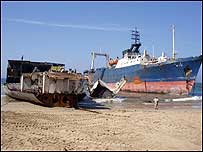 | | Ship breaking - less regulation in Pakistan |
He says that there is, "too much strict regulation in the UK with the breaking of this vessel and it takes too much time and we have no hard impossible regulation so we can meet the challenge of breaking this vessel." Having spent the best part of the day at the yard we saw very little evidence of what we would describe as health and safety, other than either equipment instructions or the behaviour of the workers.
Peter Stephenson from Able UK is the man behind the scheme to dismantle the Ghost ships in Hartlepool. We asked him what he made of these working practices abroad:
"It's sickening... it's very frightening. It's going to take years off these peoples lives."
He's convinced that the Pakistan ship could be asbestos-contaminated:
"That looks to be fibrous asbestos in a fireproof block. It's been broken and releases the fibres into the atmosphere."
So what would a Health and Safety official make of it in the UK?
"He'd have a nightmare - stop the site down immediately."
In contrast, Peter says that Able UK's work is safe: "We've been doing this work safely for 30 years. It's no different from doing a power station or a platform from a refinery. "We've done 60-odd marine structures from the North Sea oil and gas platforms. "We still recover in excess of 98% of materials from them. There's no difference and there has been no problem from our neighbours or the work we've done in that time."
He finds it frustrating to see the so-called ghost ships still sitting in Teesside when he knows that other ships have been broken up in Pakistan:
"Words fail me. It's so frustrating because they're doing so wrong over there. It's detrimental to the environment and people are getting killed and injured. "And it could all be done right here and it's good business for the area and we need the jobs and it's good for the local economy." Best practice So what's the Government's policy when it comes to disposing of our own ships?
It says that dismantling should be in line with what it describes as 'best practice'.
Wally Mandryk from Lloyds Maritime Intelligence Unit says: "If a ship has hazardous material on board, and many of them do, then I think best practice would require these ships to be scrapped at facilities that are licensed, and have resources and facilities to remove the materials before they're fully scrapped."
Surely that should rule out Gaddani so how did Sir Geraint get there? The sale of Sir Geraint was handled by a firm called Babcocks - a kind of estate agents for the Navy.
She wasn't actually sold for scrap - but as a trading vessel - and this was already raising eyebrows in shipping circles.
Wally Mandryk says: "My great surprise was that this vessel was sold for trading in the first place. "The ship was nearly 38 years old - in shipping terms that's an ancient vessel. "Very few vessels, if at all, trade at that age. So it would be a reasonable assumption that the vessel wasn't meant for trading and it was destined for the scrapyard sooner or later."
Whether or not Babcocks believed Sir Geraint would be used for trade, they covered their backs by telling her new owners she contained a large amount of asbestos, and made them sign a legal contract governing her long term future. We've managed to see that contract and it states that if the new owner of the Sir Geraint scraps her, or sells her for scrap, they must do so in line with environmental best practice and health and safety rules. Surely that should have ruled out the yard in Pakistan? Regency Projects It's time for a look at who bought the Sir Geraint. Regency Projects is a company incorporated in England for the purposes of breaking ships.
They purchase ships, take them to the Far East, and sell them to a breaker.
It's a company controlled by Mr Saleem Ali - he has a long history of this type of work. 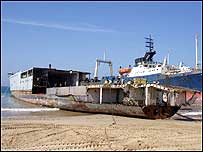 | | Dismantling the Geraint in Pakistan |
He had several companies before. It's a little self contained operation at the bottom of the shipping market. So why did the Government sell their ship to a well known third world ship breaker? Regency Projects claim they had nothing to do with Sir Geraint's dismantling.
They say they sold her on to a third party, Malvern Shipping, and it was them who scrapped her.
Regency and Malvern coincidentally share the same office at this address in London - and Regency continued to maintain the Sir Geraint until she was scrapped. Regency Projects didnt want to be interviewed but they said information about asbestos on Sir Geraint was passed on when she was sold and she was broken up by a firm with a good reputation. So did the government fail to check up on who they sold Sir Geraint to, or did they simply turn a blind eye? We'd like to find out - but they also refused our request for an interview. Tightening up contracts Surely the Ministry Of Defence can't be happy with the way Sir Geraint was scrapped. In a statement they admitted that their contracts should be tightened up to prevent a repeat of what happened to the Sir Geraint. 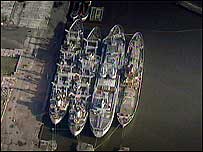 | | What next for Teesside's ghost ships? |
So it sounds like they realised they'd got it wrong.
Ahmad Saeed from the World Conservation Union believes that, "I think they have more responsibility than just selling that ship. "When they sell this ship they should ensure that all the asbestos and hazardous materials should be taken off the ship." Roger Symes thinks that the government was probably very happy just to get rid of the ship: "Removing the asbestos from a ship such as this one is highly expensive and would probably cost more than the value of the ship. "So if they could get away without doing that it would certainly be in heir best interests to do that." Double standards?
Ironically the next generation of Navy logistics ships, Sir Geraint's replacement, are being built here at Swan Hunter's on the Tyne. After that the company's order book is empty. One of the hopes for keeping the yard going is in ship dismantling.
But before Swans or any other North East company can do that. they'll have meet the rigorous health and safety checks demanded to deal with the hazards of ship breaking.
But critics say these checks count for nothing when the people doing this dangerous and demanding work are out of sight thousands of miles away:
Pakistani environmentalist Ahmad Saeed says: "There should not be any double standards. Whatever standards you follow in your country, you should follow them in the receiving country as well."
It seems that the ongoing saga of the ghost ships is set to run and run...
Links relating to this story:The BBC is not responsible for the content of external websites | 



 Inside Out - North East and Cumbria: Monday March 6, 2006