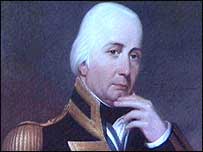
COLLINGWOOD - FORGOTTEN HEROAdmiral Lord Collingwood's presence is everywhere in North East England - on the names of streets, monuments and buildings.
But who is this forgotten hero? And what was his involvement in the Battle of Trafalgar which celebrates its 200th anniversary this year?
"Cuthbert Collingwood was modest, brave and wise but it was his devotion to king and country and his unwavering sense of duty that set him apart." Charles Collingwood.
Cuthbert Collingwood is known as "the Northumbrian who saved the nation", but he's also a forgotten North East hero. He's the man who saved the British Navy together with his close friend Horatio Nelson at the Battle of Trafalgar. His devotion to duty was such that even after Trafalgar he continued to ensure that Britain ruled the waves in the 18th and early 19th Centuries. But who was the man behind the little-known legend? A commanding presence Most of us know the name Collingwood from walking down his street in Newcastle or past his imposing monument in Tynemouth. Admiral Lord Collingwood was a colossus of a man, but few remember his crucial role in Britain's naval history. 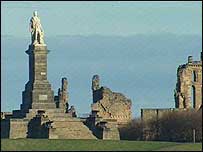 | | Modest Collingwood's name has sunk with little trace |
He fired the first shot at Trafalgar, and took over command of the British fleet after the death of his friend Nelson. But whilst Nelson's name has been immortalised, Collingwood's good name only seems to survive through his family tree. This modest man is largely a background player in most history books, yet his contribution was immense. When his memorial was unveiled it was said that: "He was a typical north countryman - never duly elated by success or depressed by failure, caring little little for public applause".
Early years| Collingwood fact file | Cuthbert Collingwood was born on October 24, 1748 in Newcastle. He was the son of a local merchant. Educated at the Royal Free Grammar School in Newcastle. Joins the Royal Navy straight from school and rises through its ranks.
Tried by court martial in 1777 for disobedience of orders but acquitted. Marries Sarah Blackett in 1791 and sets up home Morpeth. Serves in command of The Excellent in 1797 in St Vincent. Second in command to Nelson at Battle of Trafalgar in 1805. Dies at sea off Minorca on the Ville De Paris in 1810. Buried in St Paul's Cathedral in London's. Source: Cuthbert Collingwood - The Northumbrian who Savedthe Nation" by Andrew Griffin. |
Cuthbert Collingwood was born and bred on the banks of the river Tyne. After being educated at the city's Royal Grammar School, he joined the Navy in 1761 when he was just 12-years-old. He sailed out of the Tyne on board the Shannon, a frigate on which he was to learn the rudiments of seamanship. Under the guidance of his uncle he served as as midshipman. By 1772, Collingwood was an experienced seaman, and he was sent to Jamaica where he met another midshipman by the name of Horatio Nelson. Both were to rise through the ranks together serving their country in foreign seas. It was the start of a life-long friendship between the two men. Despite their ambitions there was never any jealousy between them. This state of mutual admiration continued until the Battle of Trafalgar, when Nelson was given the command over the more experienced Collingwood. HomegroundCollingwood's Navy career was to take him all over Europe, North America and the West Indies. His visits home to the North East of England were few and far between. In 1801 Collingwood met his family in Portsmouth as he could not be released to travel North himself. The 400 mile journey would have taken his family at least two weeks on difficult roads. It was one of a limited number of occasions when Collingwood met his wife over the course of his career - he only ever spent three years on dry land. Battle of Trafalgar"The history books tend to give all the glory to Nelson. In fact, they were equal partners." Historian Andrew Griffin.
The Battle of Trafalgar has become inextricably linked with the name of Lord Nelson, but Collingwood's involvement was huge. The battle remains one of the most famous and crucial in British naval history, and celebrates its 200th anniversary this year. On October 21, 1805 the combined forces of France and Spain were annihilated by the English fleet following a bloody battle. 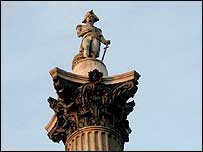 | | Charismatic Nelson overshadowed Collingwood |
There were many heroes that day, not least Nelson, who was mortally injured in the fighting. As Nelson lay dying, Collingwood took control amongst the thunderous battle that raged all around him. In routing the French and Spanish enemy forces from his ship, the Royal Sovereign, Collingwood defeated the foreign forces.
Had the Royal Navy lost the battle, Napoleon with his 115,000 troops based at Boulogne, would have swept across the channel and invaded England. With Collingwood's help the British Navy did not lose a single ship at Trafalgar, and the country was saved from invasion. Planting acornsCollingwood's commitment to the Royal Navy's supremacy didn't stop in battle. When back home Collingwood planted acorns at every opportunity to boost future stocks of timber for British ships. 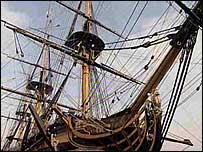 | | Victory was made from 3,000 English oak trees |
He knew that it took 2,000-3,000 oaks to build a ship like Victory. He was concerned that the British had enough oak to replenish the ageing fleet when the time came. Collingwood acquired land in the Cheviots at College Valley in Northumberland, and created forestry plantations there. Ironically ship technology was to change in the 19th Century, and ships would be built out of iron rather than wood. Later life"Whenever I think how I am to be happy again, my thoughts carry me back to Morpeth."
After his famous victory, Collingwood received a pension of £2,000 per annum and was made Baron Collingwood. Despite his time away from home Collingwood remained very fond of his Northumberland roots. Sadly he was never to return to his family in Morpeth after Trafalgar - he died at sea near Minorca in 1810. Treasure hunt "See how that noble fellow Collingwood takes his ship into action". Collingwood Monument.
Today Collingwood is celebrated on buildings and memorials around the North East. Tracking down places with links to the great man is a bit of a treasure hunt.
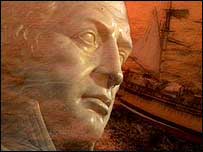 | | Rescuing Collingwood - restoring the hero's reputation |
Why not follow our guide to places associated with the hero of Trafalgar in our photo gallery. Perhaps the most poignant monument to Collingwood is his statue at Tynemouth which looks out to sea proudly.
And there are signs that Collingwood's name is being reclaimed as a new generation discovers him. Morpeth Town Council and school children recently planted an avenue of 12 oak trees along the bank of the River Wansbeck from Oldgate Bridge to honour the forgotten hero. It's a fitting tribute to the man who was instrumental in saving Britain from invasion. Join the huntPerhaps you can find the missing piece of the Collingwood jigsaw? 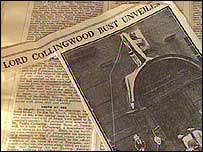 | | Join the hunt for the missing Collingwood bust |
The famous bust of Lord Collingwood once decorated a building on Newcastle's Side. It was later moved to St Nicolas' Cathedral, but has been missing for sometime. Inside Out would like to hear from you if you think you know the whereabouts of this important statue - email insideout@bbc.co.uk | 



 Inside Out - North East: Monday February 28, 2005