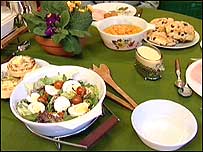
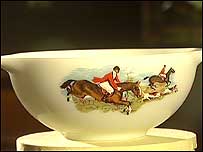
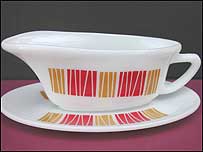
Pyrex - modern iconNo matter where you live you've probably got a little piece of Sunderland in your home.
The city produced Pyrex, a revolutionary type of glass that became a "must-have" in kitchens throughout the world.
You've probably got some hiding in a cupboard right now. We asked actress Wendy Craig, who is something of a Pyrex fan, to investigate. History in the makingJ.A. Joblings started making Pyrex in Sunderland in 1922. The company had fallen on hard times, but a new recruit to the family business, Ernest Jobling Purser, had heard about a technique for making glass that wouldn't crack or shatter in an oven. 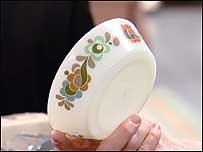 | | Every single piece of Pyrex came from Sunderland. |
American industrial glassmakers Cornings had stumbled on Pyrex. Joblings saw its potential and secured the licence to make and sell it across the Empire. They suddenly had a near world-wide market. Since the 1920's millions of casseroles, bowls, dinner services and measuring jugs have been churned out at the Joblings factory in Millfield. Its glassware made Pyrex a household name around the world. Revolution in the kitchen Pyrex was part of a social revolution. After the First World War and the disappearance of domestic servants, middle class women were forced into the kitchen. 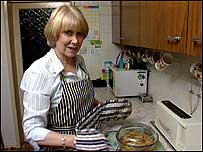 | | Wendy Craig cooks up a feast with her Pyrex glassware |
Pyrex was the first domestic item marketed directly at the housewife. But few people realised just the impact that the introduction of a heat resistant glass would have. It was a godsend for the new domestic goddesses because you could safely take it from the oven straight to the table. It was also presentable enough to impress guests, and was easily washed up afterwards. Also, it made housewives more confident about getting good results in the kitchen. Commando casserole Pyrex even tried to make a virtue of shortages in World War 2, encouraging housewives to use the glassware for more economical recipes like Commando Casserole. 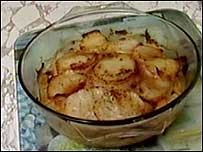 | | Commando Casserole - hearty fare cooked in a Pyrex dish |
The advert boasted that because all the ingredients went in one casserole, the glass retained heat so saving fuel. And because the dish went straight to the table, there was no waste and less washing up! We asked actress Wendy Craig, who famously cooked up mealtime disasters as Ria in TV's 'Butterflies', to cook the casserole using Pyrex. Why not try the recipe at home for yourself... 1lb potatoes
1lb parsnips or turnips
1 leek or small onion
1 teaspoon veg. or meat extract dissolved in one teacup of water
1/2 teaspoon of thyme
1lb sausage meat
Part of a small cabbage
Pinch of sage
Small piece of dripping
Salt and pepper * Shred cabbage finely. Slice other vegetables as thin as paper.
* Roll out sausage meat on a well-floured board and cut into four pieces, the size of the Pyrex casserole. * Grease the casserole, and put in alternate layers of vegetable and sausage, sprinkling seasoning in between. * Let first and last layer be potato slices. * Pour in gravy. Put on lid and cook in moderate oven for 30 minutes. * Take off the lid, dot the top potatoes with tiny pieces of dripping and return to oven for 20 minutes.
Collectable Pyrex Pyrex has had many different styles and designs down the years.
Early on the company attempted to make it ornate, but the glassware really took off when it became a basic must-have household item. When white Pyrex came along, designs could be added - and sales went through the roof.  | | Checking for the Pyrex and Jobling mark on glassware |
At its height 3,000 people worked at the Sunderland factory.
Pyrex was flying off the shelves - not least because it was desirable and durable. So how valuable is traditional Pyrex today in terms of their collectability? Wendy Craig visited a leading auctioneer to have a couple of old items valued. She spoke to Rod Meek of Anderson and Garland who told her that the items aren't worth much because they are not retro enough yet. If you're searching the backs of your cupboards for older Pyrex, it's worth looking out for the JAJ symbol on the bottom. Future of PyrexSo what about in the future? Sadly Pyrex might become more collectable for all the wrong reasons - it won't be made in Sunderland any more. The factory has had a number of different foreign owners in recent years and in September 2007 it will close and production will move to France. Glassmaking is coming to an end in Sunderland, so next time you get your humble casserole out of the oven, cherish it that little bit more! Links relating to this story:The BBC is not responsible for the content of external websites | 



 Inside Out - North East: Monday February 23, 2007